
Disclosure: As an Amazon Associate I earn from qualifying purchases. Learn more
Tennis elbow can make gripping, lifting, and racquet practice uncomfortable. A TENS unit may offer temporary, drug-free pain relief by delivering mild electrical stimulation through electrodes, but the right choice depends on how you want to apply it, how much control you need, and whether you prefer a wrap or separate pads. Our top pick is the Beurer EM29, which is made to fit the elbow or knee; the other options offer more traditional pad-based setups and different control features.
TENS is not a cure for tennis elbow or a substitute for medical care. Follow the device instructions, and ask a healthcare professional whether TENS is appropriate for you—especially if you have an implanted medical device or another health concern.
Quick Comparison
| TENS Unit | Application Style | Standout Features | Best For |
|---|---|---|---|
| Beurer EM29 2-in-1 Knee and Elbow TENS Machine | Reusable electrode wrap | 20 intensity levels, four programs, treatment timer | A direct elbow-focused fit |
| TENS 7000 Digital TENS Unit | Separate electrode pads | Multiple modes, two lead wires, four reusable pads | A traditional, versatile pad setup |
| TENS 7000 Rechargeable TENS Unit | Separate electrode pads | Rechargeable battery, adjustable settings, four electrodes | People who prefer rechargeable power |
| EMPI Select TENS Pain Control Unit | Electrotherapy unit | Five preset modes, four customizable modes, session tracking | People who want detailed control options |
| TENS 7000 Pro Rechargeable TENS Unit | Four-channel pad system | Rechargeable battery, four channels, eight pads | People seeking more channels and pad coverage |
Our Picks: Best TENS Units for Tennis Elbow reviews
1. Beurer EM29: Best Elbow-Focused Wrap

The Beurer EM29 is the most purpose-built option here for someone shopping specifically for tennis elbow. Instead of placing separate adhesive pads around the arm, you secure the wrap around the elbow and use its integrated electrodes. The same wrap can also be used on a knee, and its stated fit range is 9.8 to 27.8 inches.
You can choose from four programs and adjust the intensity across 20 levels. A built-in timer, auto shutoff, lock function, and simple display add useful controls without requiring a separate set of lead wires. It runs on AAA batteries, which are included, and the electrodes are reusable: the instructions call for wetting them before use. The manufacturer says gel and replacement pads are not needed.
This design may be easier to manage than placing multiple pads on a small area, though a wrap is less flexible for targeting different body locations than a conventional pad-based unit. Check the fit and follow the placement and use instructions. Beurer also says not to use this product on a body part with a metal implant, such as a knee replacement containing metal components.
Pros:
- Wrap designed for use on the elbow or knee
- 20 intensity levels and four programs
- Reusable electrodes do not require gel or replacement pads, according to the product description
- Includes a timer, auto shutoff, and lock function
Cons:
- Less adaptable to other body areas than a unit with separate pads
- Requires AAA batteries and wetting the electrodes before use
Verdict: Choose the Beurer EM29 if an elbow-specific wrap and reusable electrodes matter more to you than broad placement options.
2. TENS 7000 Digital: Best Traditional Pad-Based Option
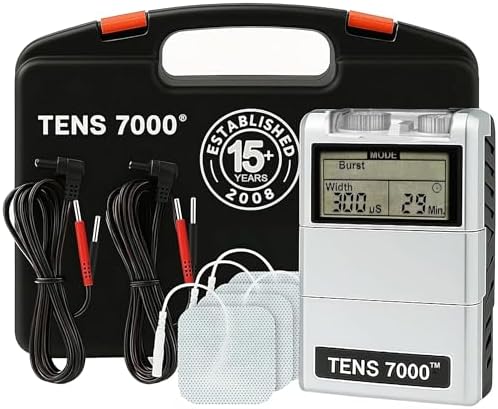
The TENS 7000 Digital uses separate electrode pads connected to the unit by lead wires. That layout gives you more flexibility in where you place the pads than the Beurer wrap, which can be useful if you want a device that is not limited to the elbow. The product description lists tennis elbow among the conditions it is intended to address.
The package includes two lead wires, four reusable electrode pads, a 9V battery, a user manual, and a hard carrying case. It also offers multiple TENS modes. The supplied product information does not specify the number of intensity levels or provide a detailed program list, so check the unit’s instructions if those details are important to you.
The main tradeoff is the pad-and-wire setup: you will need to position the electrodes and keep track of the leads, rather than simply fastening a wrap. The included battery also means this model is not the rechargeable option in the lineup. Compared with the TENS 7000 Rechargeable, this version comes with a carrying case and a stated battery type, but does not have a built-in rechargeable battery.
Pros:
- Separate pads allow flexible placement
- Includes four reusable electrode pads and two lead wires
- Multiple TENS modes are listed
- Comes with a hard carrying case and 9V battery
Cons:
- Pad placement and lead wires take more setup than an elbow wrap
- Uses a replaceable 9V battery rather than built-in rechargeable power
Verdict: This is a practical choice if you want a conventional pad-based TENS unit with a case and included accessories, and do not mind setting up separate electrodes.
3. TENS 7000 Rechargeable: Best for Cord-Free Power

This TENS 7000 model keeps the familiar separate-pad approach but adds a built-in rechargeable battery. That can be appealing if you would rather recharge a device than keep spare disposable batteries on hand. The package includes four electrodes, and the unit has adjustable settings for tailoring the stimulation.
The product description lists a maximum output of up to 100 mA. That figure describes the unit’s stated capability; it is not a recommended setting or a reason to start at high intensity. Begin according to the instructions and use only a comfortable level. The product is described for several body areas, so it may suit someone who wants one device for elbow discomfort and other areas as directed by its manual.
Unlike the Beurer, this model does not use an elbow-shaped wrap, so you need to place the electrodes yourself. The supplied information does not give a specific list of programs or intensity levels. If you want more detailed session tracking or documented output controls, the EMPI Select provides more of those specifications.
Pros:
- Built-in rechargeable battery
- Includes four electrodes for pad-based use
- Adjustable settings for choosing a comfortable stimulation level
- Designed for use on multiple body areas, following the instructions
Cons:
- Requires separate electrode placement rather than an elbow-specific wrap
- The supplied product details do not list exact programs or intensity levels
Verdict: Pick this model if rechargeable power is your priority and you are comfortable using separate electrode pads.
4. EMPI Select: Best for Customizable Controls

The EMPI Select stands out for the amount of control information provided. It has five preset modes and four customizable modes, plus a compliance monitor that keeps session records. Those features may be useful if you want to track your use or adjust settings, rather than rely only on a small set of preset options.
The unit’s listed output ranges from 0 to 60 milliamps, with pulse rates from 2 to 150 pulses per second and pulse duration up to 400 microseconds. These are technical specifications, not a treatment plan. Follow the device directions and any guidance from your healthcare professional when selecting settings.
The product can run on three alkaline AAA batteries or rechargeable batteries, but the supplied information does not say that a rechargeable battery is built in. That makes its power setup different from the rechargeable TENS 7000 models. The product details also do not specify the number of included pads or lead wires, so confirm the package contents before buying if you need those accessories.
Pros:
- Five preset modes and four customizable modes
- Session tracking through a compliance monitor
- Provides detailed pulse and output specifications
- Can use alkaline AAA batteries or rechargeable batteries
Cons:
- Rechargeable batteries are not described as built in
- The supplied details do not list included pads or lead wires
Verdict: Consider the EMPI Select if customizable settings and session tracking are more important to you than an elbow-specific wrap or a built-in rechargeable battery.
5. TENS 7000 Pro: Best for More Channels and Pads

The TENS 7000 Pro is the most accessory-rich option in this group. It has four channels and comes with eight electrode pads, offering more pad connections than the standard TENS 7000 package or the four-electrode rechargeable model. It also has a built-in rechargeable battery, so you do not have to rely on disposable batteries for power.
Its adjustable modes and intensity settings are intended to let you tailor stimulation, while the pad-based design allows placement on different body areas as directed by the manual. For tennis elbow, that flexibility can be helpful if you want a device that may also serve other needs. However, the extra channels and pads may be more than you need if your main goal is a straightforward elbow treatment setup.
The product description mentions EMS as well as TENS, but does not provide detailed instructions for using each function. Read the manual carefully before choosing a mode, and do not assume that every setting is suitable for elbow pain. The Beurer is a simpler match if you prefer an integrated wrap over a more involved pad setup.
Pros:
- Four channels and eight electrode pads
- Built-in rechargeable battery
- Adjustable modes and intensity settings
- Pad-based design can serve multiple body areas as directed
Cons:
- More channels and pads may add complexity for a single elbow area
- Requires positioning and managing separate electrodes
Verdict: Choose the TENS 7000 Pro if you want a rechargeable unit with more channels and pads; for a simpler elbow-focused setup, the Beurer EM29 is a better fit.
How to Choose a TENS Unit for Tennis Elbow
Choose a wrap or separate pads
A wrap such as the Beurer EM29 is designed to fit around the elbow, which may make placement feel more direct. Its stated fit range is 9.8 to 27.8 inches, so measure as needed and check whether the fit works for you. Separate pads, as used by the TENS 7000 models, can be placed in different positions and may be more versatile across body areas, but they require more setup. Follow the manual for electrode placement rather than guessing where pads should go.
Look for controls you will actually use
Intensity adjustment matters because comfortable stimulation is personal. The Beurer lists 20 levels, while the EMPI Select provides preset and customizable modes along with detailed output specifications. Other products in this group describe adjustable settings but do not give the same level of detail. More settings are not automatically better; a clear control layout and instructions may matter more if you want simple operation.
Consider how you want to power the unit
The Beurer and standard TENS 7000 use replaceable batteries, with AAA batteries included for the Beurer and a 9V battery included for the standard TENS 7000. The two rechargeable TENS 7000 models have built-in rechargeable batteries. The EMPI Select can use alkaline AAA batteries or rechargeable batteries, but its product details do not describe an internal rechargeable battery. Choose based on whether you prefer charging or replacing batteries.
Check what the package includes
Included accessories can affect how ready a unit is to use. The standard TENS 7000 lists two lead wires, four reusable pads, a 9V battery, and a carrying case. The rechargeable TENS 7000 includes four electrodes, while the Pro includes eight pads. The Beurer uses built-in reusable electrodes rather than separate pads. For the EMPI Select, the supplied description does not list pads or lead wires, so verify the package contents before ordering.
Match the device to your treatment routine
A built-in timer and auto shutoff, as found on the Beurer, can help keep a session bounded. The EMPI Select’s compliance monitor is intended to record sessions. If you want to use a device in more than one location, a pad-based model may offer more placement flexibility, while an elbow wrap may be more straightforward for that one area. Think about where you will use it and how much setup you are willing to do.
Review safety guidance before use
Read the complete instructions before using any electrical stimulation device, and follow its warnings and pad-placement directions. The Beurer specifically says not to use its wrap on a body part with a metal implant, such as a knee replacement containing metal components. If you have an implanted device, a medical condition, or uncertainty about whether TENS is appropriate, consult a healthcare professional before use. Stop if stimulation causes discomfort and seek medical advice for persistent or worsening symptoms.
Frequently Asked Questions
Can a TENS unit help with tennis elbow?
TENS units are designed to deliver electrical stimulation that may provide temporary pain relief. They do not correct the cause of tennis elbow, and results can vary. Ask a healthcare professional about your symptoms and whether TENS fits into your care plan.
Which unit is most directly designed for elbow use?
The Beurer EM29 is the clearest elbow-focused choice in this group because it uses a wrap intended for either the elbow or knee. Its electrodes are built into the wrap and need to be wetted before use, according to the product description.
Are electrode pads or an elbow wrap easier to use?
That depends on your preference. A wrap avoids arranging separate pads, while separate pads offer more placement flexibility. Review each product’s instructions and choose the format you are more comfortable setting up.
Do these TENS units use rechargeable batteries?
The TENS 7000 Rechargeable and TENS 7000 Pro have built-in rechargeable batteries. The Beurer EM29 uses AAA batteries, and the standard TENS 7000 includes a 9V battery. The EMPI Select can use alkaline AAA or rechargeable batteries, but its product description does not say that it has a built-in rechargeable battery.
Can I use a TENS unit on other body areas?
Several products are described for use on multiple body areas, but the appropriate placement depends on the device and its instructions. Use the unit only as directed in its manual, and ask a healthcare professional if you are unsure about a particular area.
Can I use the Beurer EM29 if I have a metal implant?
The product description says not to use the Beurer on a body part with a metal implant, including a knee replacement that contains metal components. If you have an implant or another medical device, check with a healthcare professional before using any TENS unit.
When should I get medical advice for elbow pain?
Consider medical advice if the pain is persistent, getting worse, or interfering with normal activities. A healthcare professional can help assess the cause and discuss care options; a TENS unit should not take the place of that evaluation.
Final Recommendation
For most shoppers focused specifically on tennis elbow, the Beurer EM29 is the most straightforward match because it uses an elbow-and-knee wrap with adjustable intensity and reusable electrodes. If you prefer flexible pad placement, consider the standard TENS 7000; if rechargeable power is important, look at one of the rechargeable TENS 7000 models. Choose the EMPI Select if session tracking and customizable controls stand out to you. Whichever unit you choose, follow its instructions and check with a healthcare professional if you are unsure whether TENS is appropriate.