
Disclosure: As an Amazon Associate I earn from qualifying purchases. Learn more
Choosing among Tennis Tutor machines comes down to matching the machine’s pace and shot options to your practice goals. Some models offer simple, repeatable feeds, while others add spin, random placement, or patterns designed to mimic a real opponent. Below, we compare five options by speed, capacity, power, and the kind of training each supports.
Quick Comparison
| Machine | Best for | Ball speed | Capacity | Power |
|---|---|---|---|---|
| Tennis Tutor Prolite | All-around practice | 10–70 mph | 125 balls | Rechargeable battery |
| Tennis Tutor Prolite Plus | Practice with topspin or underspin | 10–75 mph | 110 balls | Rechargeable battery |
| Sports Tutor Tennis Twist | Beginners and casual practice | Adjustable toss to 12–20 feet | 28 balls | Six D batteries, not included |
| Tennis Tutor Prolite Player | Player-like shot patterns | 10–85 mph | 110 balls | Rechargeable battery |
| Sports Tutor eCannon | Intermediate and advanced players | 20, 35, or 45 mph | 70 balls | Rechargeable battery |
Our Picks: Best Tennis Tutor Tennis Ball Machines reviews
1. Tennis Tutor Prolite: A versatile machine for everyday drills

The Prolite is a straightforward choice for players who want to work on groundstrokes, lobs, and movement without dealing with an app or complex programming. Knob controls let you adjust the speed and feed interval, while the built-in random oscillator sends balls across the court to help you practice moving into position.
Its speed range of 10 to 70 mph and adjustable interval—from 1.5 to 10 seconds—gives you room to shift between quick reaction drills and a slower practice rhythm. The machine holds up to 125 balls, the largest capacity in this group. It weighs less than 30 pounds and has a fold-out towing handle and caster wheels for transport.
The rechargeable battery is rated for up to four hours per charge. That is useful for longer practice sessions, though the machine needs to be charged overnight according to the product information. The Prolite is a strong middle ground if you want a full-size machine with random placement but do not need selectable spin or advanced player simulation.
Pros:
- Large 125-ball capacity
- Random oscillator supports movement drills
- Simple knob controls and no app required
- Up to four hours of stated battery run time
Cons:
- Does not offer a selectable topspin or underspin setting
- Maximum speed is lower than the Prolite Plus and Prolite Player
Verdict: Choose the Prolite if you want easy controls, a generous ball supply, and random court placement in one practical machine.
2. Tennis Tutor Prolite Plus: Simple access to topspin and underspin
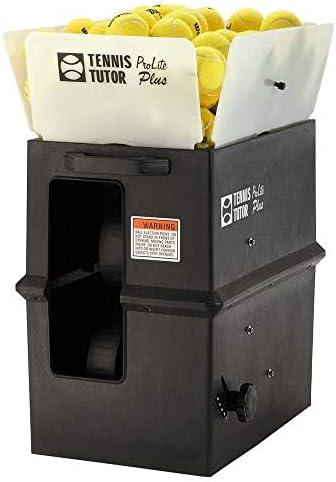
The Prolite Plus builds on the basic Prolite format with a one-touch spin switch. Select topspin or underspin to add a medium amount of that spin to all shots. The control is intentionally simple, making this a good option if you want to practice handling different ball behavior without setting up complex drills.
It throws balls at speeds from 10 to 75 mph and has an adjustable feed interval from 1.5 to 10 seconds. Like the Prolite, it includes a random oscillator for side-to-side movement practice and supports groundstrokes through lobs. The 110-ball capacity is slightly smaller than the Prolite’s, and the machine has a towing handle and large wheels for rolling.
The product information lists up to four hours of operation per charge, with an included smart charger. One trade-off is that the spin setting applies to all shots rather than letting you vary spin from ball to ball. Compared with the Prolite, you give up some capacity in exchange for spin selection and a slightly higher top speed.
Pros:
- One-touch topspin or underspin selection
- Speed range reaches 75 mph
- Random oscillator and adjustable feed interval
- Rechargeable battery with up to four hours of stated play time
Cons:
- Spin is applied to all shots rather than varied across a sequence
- Holds 15 fewer balls than the Prolite
Verdict: Pick the Prolite Plus if practicing against spin matters more to you than getting the largest ball capacity.
3. Sports Tutor Tennis Twist: A compact starter for new players

The Tennis Twist takes a simpler approach than the full-size machines. It is designed for beginners and tosses a ball every five seconds, with the toss adjustable from 12 to 20 feet. Its 28-ball capacity is modest, but the compact setup can work well for introducing a new player to basic contact and timing practice.
At 10 pounds, it is the lightest option here and has a built-in carrying handle. It runs on six D-size alkaline batteries, which are not included; the stated operating time is typically eight to ten hours with six new batteries. It can also handle oversize tennis balls and pickleballs, and the product information notes that it can be used to toss tennis balls for beginner baseball practice.
This is not a substitute for the Prolite models if you want fast feeds, random court placement, or a large supply of balls. Its fixed five-second interval is less flexible, and its toss-based design is aimed at basic practice rather than demanding match-play drills. For a young or new player, however, the simpler format may be exactly what you need.
Pros:
- Lightweight at 10 pounds with a carrying handle
- Adjustable toss height from 12 to 20 feet
- Accepts regular and oversize tennis balls and pickleballs
- Stated battery operation of eight to ten hours with new alkaline batteries
Cons:
- Small 28-ball capacity and fixed five-second feed interval
- Requires six D batteries, which are not included
Verdict: Choose the Tennis Twist for portable, introductory practice rather than advanced rallies or varied court-placement drills.
4. Tennis Tutor Prolite Player: Patterns that imitate an opponent

The Prolite Player is the most feature-rich choice in this lineup. Its patented Player Mode is designed to simulate beginner, intermediate, and advanced opponents by changing shot speed, spin, side-to-side position, and depth. If you want practice that varies more than a steady feed, this model offers a more structured way to work on positioning and shot response.
It reaches speeds of 10 to 85 mph and includes electronic elevation for groundstrokes and lobs. The controls let you choose topspin or underspin, while a dual 2-line oscillator can alternate forehand and backhand shots or serve two players at once. Narrow or wide spacing is selectable, and a separate random oscillator is also included.
The machine holds 110 balls and weighs less than 40 pounds. Its built-in rechargeable battery is rated for four to six hours per charge. More settings and training modes make it less minimal than the knob-controlled Prolite models, so it is best suited to players who will make use of the extra variety. It is also the heaviest option in this comparison.
Pros:
- Player Mode varies speed, spin, shot position, and depth
- Fastest listed top speed at 85 mph
- Dual 2-line and random oscillation options
- Electronic elevation and selectable topspin or underspin
Cons:
- Weighs more than the other machines listed here
- Its extra controls may be unnecessary for basic, repeatable drills
Verdict: The Prolite Player is the best fit if you want varied, player-like patterns and expect to use its expanded training controls.
5. Sports Tutor eCannon: A compact option for topspin practice

The eCannon is a compact machine for intermediate and advanced players who want to practice groundstrokes and volleys with topspin. It has three speed settings—20, 35, and 45 mph—and automatically adjusts the time between shots based on the selected speed. Two pushbuttons keep operation simple.
At 23 pounds, it is lighter than the full-size Prolite models and has a built-in carrying handle. The 70-ball capacity is enough for a shorter practice set, but it requires more frequent reloading than the Prolite machines. Its rechargeable battery is rated for up to two hours per charge, so it is less suited to extended sessions without a recharge.
The fixed topspin focus is also an important limitation: this model is intended for intermediate and advanced players, not beginners. It does not list an oscillator, so it is a better match for focused, repeatable shot practice than for drills that require the machine to move balls around the court.
Pros:
- Compact design weighs 23 pounds
- Simple two-button operation
- Three speed settings with feed timing that adjusts to speed
- Built-in topspin for groundstroke and volley practice
Cons:
- Topspin-only design is not intended for beginners
- 70-ball capacity and up to two hours of stated battery life are limited compared with the Prolite models
Verdict: Choose the eCannon if you are an intermediate or advanced player who values a lighter machine and focused topspin practice.
How to Choose a Tennis Tutor Tennis Ball Machine
Match the machine to your skill level
For new players, a predictable toss and straightforward feed can make it easier to focus on contact and timing. The Tennis Twist is the simplest fit in this group. Players who already have consistent strokes may get more from a wider speed range, spin settings, or a machine that changes shot placement. The eCannon is specifically aimed at intermediate and advanced players, while the Prolite Player offers the broadest range of training patterns.
Choose the right kind of shot variation
Consider whether you want to repeat one shot or practice reacting to different ones. A random oscillator spreads feeds across the court, which can add movement to a session. The Prolite Player adds dual-line patterns and a Player Mode that varies speed, spin, position, and depth. If your main goal is practicing against spin, the Prolite Plus offers a simple topspin or underspin selection, while the eCannon focuses on topspin.
Think about speed and feed timing
A broad speed range gives you flexibility as your practice needs change. The Prolite Player reaches 85 mph, followed by the Prolite Plus at 75 mph and the Prolite at 70 mph. The eCannon has three fixed speed settings. Feed timing matters too: the Prolite models let you adjust the interval, while the Tennis Twist feeds every five seconds and the eCannon automatically adjusts its interval with speed.
Check ball capacity against your drill length
A larger hopper means fewer interruptions to collect and reload balls. The Prolite holds 125 balls, the Prolite Plus and Prolite Player each hold 110, the eCannon holds 70, and the Tennis Twist holds 28. If you expect to practice for a long stretch or want to keep drills flowing, capacity should be a key part of your decision.
Plan for power and charging
The Prolite, Prolite Plus, Prolite Player, and eCannon use built-in rechargeable batteries. Their stated run times range from up to two hours for the eCannon to up to four hours for the Prolite and Prolite Plus, and four to six hours for the Prolite Player. The Tennis Twist uses six D-size alkaline batteries, which are not included. Choose based on how long you practice and whether you prefer rechargeable power or replaceable batteries.
Consider transport and storage
Weight and handling can matter if you need to move the machine between your car, storage area, and court. The Tennis Twist weighs 10 pounds and has a carrying handle. The eCannon weighs 23 pounds and also has a handle. The Prolite has caster wheels and a fold-out towing handle, while the Prolite Plus has a towing handle and large wheels. The Prolite Player weighs less than 40 pounds and includes a towing handle and wheels.
Frequently Asked Questions
Which Tennis Tutor machine is best for most players?
The Prolite is a versatile starting point for players who want adjustable speed and feed timing, a random oscillator, and a large 125-ball capacity. If spin selection is important, consider the Prolite Plus instead.
Which model is best for beginners?
The Tennis Twist is designed for beginners and offers a simple toss with an adjustable height. Its small capacity and fixed five-second interval make it less flexible than the larger machines, but its 10-pound weight makes it easy to carry.
Which machine offers the fastest ball speed?
The Prolite Player has the highest listed maximum speed in this group at 85 mph. The Prolite Plus reaches 75 mph, and the Prolite reaches 70 mph.
Can these machines feed balls randomly across the court?
The Prolite, Prolite Plus, and Prolite Player list random oscillation. The Prolite Player also offers a dual 2-line oscillator for alternating sides or practice with two players. The Tennis Twist and eCannon do not list an oscillator in the supplied product details.
Which models let you choose topspin or underspin?
The Prolite Plus has a one-touch selection for medium topspin or underspin, and the Prolite Player lets you choose topspin or underspin. The eCannon shoots all balls with topspin rather than offering a choice between spin types.
How long does the battery last?
Stated run time varies by model: up to four hours for the Prolite and Prolite Plus, four to six hours for the Prolite Player, and up to two hours for the eCannon. The Tennis Twist runs on six D-size alkaline batteries, with a typical stated operating time of eight to ten hours using six new batteries.
Final Recommendation
For a well-rounded machine with straightforward controls, a large ball capacity, and random court placement, the Tennis Tutor Prolite is the strongest all-around choice in this comparison. Choose the Prolite Plus if you want one-touch topspin and underspin, or the Prolite Player if you want more varied, opponent-style drills. Beginners looking for a lightweight starter can consider the Tennis Twist, while the eCannon is aimed at experienced players who want compact topspin practice.