
Disclosure: As an Amazon Associate I earn from qualifying purchases. Learn more
A tennis ball machine can make groundstroke practice more consistent, whether you want to groove your forehand and backhand or work on moving side to side. The right choice depends on the shots you can set, how much control you want over pace and spin, and how easy the machine is to move and recharge. Below are five options, from a compact topspin model to machines with custom drills and player-style patterns.
Quick Comparison: Best Tennis Ball Machines for Groundstrokes
| Machine | Speed | Capacity | Standout Groundstroke Feature |
|---|---|---|---|
| Sports Tutor eCannon with Topspin | 20, 35, or 45 mph | 70 balls | Compact design; adds topspin to every shot |
| Tennis Tutor Prolite Plus | 10–75 mph | 110 balls | One-touch topspin or underspin and random oscillation |
| PONGBOT Tennis Ball Machine | Up to 80 mph | 150 balls | App-based drills and multiple oscillation spots |
| Wilson Portable Tennis Ball Machine | 10–75 mph | 110 balls | Adjustable spin and electronic elevation |
| Tennis Tutor Prolite Player | 10–85 mph | 110 balls | Player Mode and dual 2-line oscillation |
Our Picks: Best Tennis Ball Machines for Groundstrokes reviews
Sports Tutor eCannon: A Compact Pick for Topspin Practice

The eCannon is a compact machine focused on straightforward groundstroke and volley practice. Its controls use two pushbuttons, and the machine weighs 23 pounds with a built-in carrying handle. That makes it a more portable option than the larger machines in this group.
It fires at three listed speeds—20, 35, or 45 mph—and adds topspin to every shot. The feed interval adjusts automatically with the speed setting. Its 70-ball capacity is smaller than the other picks here, but the machine is designed to hold about one standard pickup basket of balls.
The fixed topspin setup is useful if you want to practice handling a dipping, spinning ball. It also limits flexibility: you cannot switch to underspin, and the description specifically says this model is not for beginners. The three speed choices are less fine-grained than the adjustable ranges on the Prolite Plus, Wilson, PONGBOT, and Prolite Player.
Pros:
- Lightweight 23-pound design with a carrying handle
- Simple two-button operation
- Topspin on every shot for focused spin practice
- Internal rechargeable battery provides up to two hours of playing time per charge
Cons:
- Topspin-only operation may not suit players who want to vary spin
- Smaller capacity and shorter listed runtime than several alternatives
Verdict: Choose the eCannon if you are an intermediate or advanced player who values easy transport and wants simple, repeatable topspin groundstroke practice.
Tennis Tutor Prolite Plus: Flexible Speed and Spin for Practice
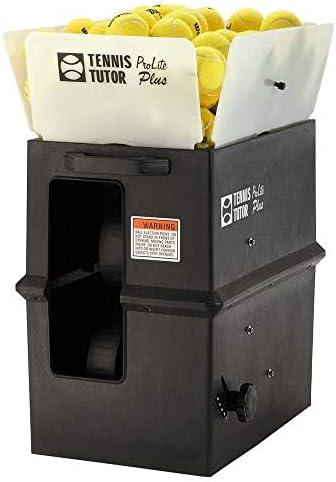
The Prolite Plus covers a wide range of practice needs, from slower groundstrokes to faster feeds and lobs. Knob controls let you adjust the machine without programming a routine or using a phone app. Its speed range is 10 to 75 mph, and the feed interval can be set from every 1.5 seconds to every 10 seconds.
A one-touch spin switch selects medium topspin or medium underspin. That makes it easy to change the incoming ball’s spin, though the listed spin options are less adjustable than the Wilson’s light-to-heavy control. The random oscillator sends balls across the court, adding movement to a baseline session.
The machine holds 110 balls and has an internal rechargeable battery rated for up to four hours of playing time per charge. It also has a towing handle and large wheels for rolling. Compared with the eCannon, it offers more speed and shot flexibility, but it is a larger machine to transport.
Pros:
- Wide 10–75 mph speed range
- One-touch selection of topspin or underspin
- Random oscillation for practicing movement across the court
- 110-ball capacity and up to four hours of listed battery runtime
Cons:
- Spin selection is limited to the listed medium topspin or underspin settings
- Does not offer the custom drill features or player simulation of some alternatives
Verdict: The Prolite Plus is a strong fit if you want a simple, no-app machine with a broad speed range, two spin choices, and random court coverage.
PONGBOT: App-Driven Drills and a Large Ball Capacity

PONGBOT is the most tech-focused choice in this lineup. It pairs app control with a remote and supports preloaded and custom drills. The product description says you can sync 30 drills from the app to the remote, and it also supports sharing and downloading drills through its user community.
For groundstrokes, the machine offers speeds up to 80 mph, 60 rps spin, and six oscillation spots. Its 150-ball capacity is the largest here, which can mean fewer interruptions to reload during a session. The listed runtime is over eight hours from its removable battery, and the machine has wheels, a pull handle, and a compact-car-trunk design.
The feature set is broad, but it also means there is more to manage than with a knob- or pushbutton-controlled machine. The description includes smart-sensor PACE S PRO features for adaptive rallies, recovery drills, and NTRP match challenges; check the specific package details to confirm which features are included with the version you are considering. It is listed for hard, clay, and grass courts, as well as padel.
Pros:
- Large 150-ball capacity
- App and remote control with custom and preloaded drills
- Up to 80 mph, 60 rps spin, and six oscillation spots
- Removable battery rated for over eight hours of runtime
Cons:
- App-based features may be more involved than basic knob controls
- Confirm package-specific smart-sensor features before choosing a version
Verdict: Pick PONGBOT if you want a large-capacity machine with app-guided drills, remote control, and a wide set of training features.
Wilson Portable Machine: Adjustable Spin and Electronic Elevation

This Wilson machine is made in partnership with Sports Tutor and combines familiar knob controls with a broad set of shot adjustments. It can throw at 10 to 75 mph, with electronic elevation control for shots ranging from groundstrokes to lobs. That range lets you set up a baseline-focused session or change the trajectory for different practice needs.
Its topspin and underspin are adjustable from light to heavy with a single control. The feed interval runs from every 1.5 seconds to every 10 seconds, and random oscillation sends shots across the court to work on movement. The 110-ball capacity and internal battery rated for up to four hours make it suited to longer sessions without constant reloading or a cord.
Compared with the Prolite Plus, this model offers more control over spin intensity, while both list a similar speed range, capacity, and battery runtime. It does not list app-based custom drills or the Prolite Player’s player-simulation mode, so its appeal is more about hands-on adjustment than programmed practice patterns.
Pros:
- Adjustable topspin and underspin from light to heavy
- Electronic elevation for groundstrokes through lobs
- Random oscillator and adjustable feed interval
- 110-ball capacity and up to four hours of listed battery runtime
Cons:
- No app or custom-drill features are listed
- Its speed range is lower at the top end than the Prolite Player and PONGBOT
Verdict: Choose the Wilson if adjustable spin and shot height matter more to you than app-based drills or automated player-style patterns.
Tennis Tutor Prolite Player: Player-Style Patterns and Two-Line Drills

The Prolite Player is built for practice that changes pace, spin, and placement rather than repeating one feed. Its patented Player Mode offers beginner, intermediate, and advanced levels. According to the product description, the mode selects speed and spin, then varies the side-to-side position and depth of shots to imitate player-style patterns.
The machine reaches up to 85 mph and covers groundstrokes through lobs with electronic elevation. You can choose topspin or underspin, and a display shows the selected amount. For paired baseline practice, the dual 2-line oscillator alternates forehand and backhand feeds, with narrow or wide spacing. A random oscillator is also included.
Its feed interval ranges from every 1.5 to every 6 seconds, and the 110-ball capacity matches the Wilson and Prolite Plus. The internal rechargeable battery is listed for four to six hours per charge. It weighs less than 40 pounds and has a towing handle and wheels, though it is not as light as the 23-pound eCannon.
Pros:
- Player Mode offers three practice levels and varied shot patterns
- Dual 2-line oscillator supports alternating forehand and backhand feeds
- Up to 85 mph with electronic elevation and adjustable spin selection
- 110-ball capacity and four to six hours of listed battery runtime
Cons:
- Heavier than the compact eCannon
- Its more advanced practice modes may be unnecessary for players who only want a steady feed
Verdict: The Prolite Player is the best fit if you want groundstroke drills that vary depth and direction or alternate between forehand and backhand patterns.
How to Choose a Tennis Ball Machine for Groundstrokes
Match the Speed Range to Your Practice Goals
For steady rally practice, you may not need the fastest machine available. Consider whether you want a slower feed to work on contact and timing, a higher pace for reaction practice, or a wide range that can support both. The eCannon has three set speeds, while the other four options list adjustable ranges. The Prolite Player and PONGBOT offer the highest listed top speeds in this group.
Decide How Much Spin Control You Need
Spin affects bounce and timing, so it can change how realistic a groundstroke drill feels. The eCannon always adds topspin. The Prolite Plus offers a one-touch choice between medium topspin and underspin, while the Wilson and Prolite Player let you adjust spin more broadly. PONGBOT lists 60 rps spin, but its supplied description does not specify the same topspin and underspin controls as the other models.
Look for Placement Options That Fit Your Drills
A machine that sends every ball to one spot can help you focus on technique, but it will not provide the same movement challenge as a changing feed. Random oscillation is listed for the Prolite Plus, Wilson, and Prolite Player. The Prolite Player also has a dual 2-line oscillator for alternating forehand and backhand shots. PONGBOT lists six oscillation spots and custom drills. Choose based on whether you want a predictable feed, side-to-side movement, or a programmed pattern.
Check Ball Capacity and Feed Interval
A larger hopper means fewer stops to reload during a practice session. The eCannon holds 70 balls, compared with 110 for the Prolite Plus, Wilson, and Prolite Player, and 150 for PONGBOT. Feed interval matters too: a faster feed can build reaction skills, while a slower one gives you more time to recover and reset. Compare the machine’s interval range with the pace you can handle while keeping your strokes controlled.
Consider Battery Runtime and Transport
All five machines have rechargeable battery options listed, but their stated runtimes vary. The eCannon is rated for up to two hours, the Prolite Plus and Wilson for up to four, the Prolite Player for four to six, and PONGBOT for over eight hours. These figures are product specifications, not a guarantee of the runtime you will get in every session. For transport, note that the eCannon weighs 23 pounds, while PONGBOT has a pull handle and wheels and the Prolite Player weighs less than 40 pounds.
Choose Between Simple Controls and Programmed Practice
If you want to adjust settings directly on the machine, the eCannon’s pushbuttons and the knob controls on the Prolite Plus and Wilson are straightforward options. The Prolite Player adds pushbutton controls and programmed Player Mode. PONGBOT offers app and remote control, custom drills, and drill sharing. More features can add training variety, but consider whether you will use them before choosing a more tech-focused setup.
Frequently Asked Questions
What matters most in a tennis ball machine for groundstrokes?
Look for a speed range you can use, useful spin settings, and placement options that match your drills. Capacity, battery runtime, and portability also affect how practical the machine will be for your practice sessions.
Which of these machines can vary ball placement?
The Prolite Plus and Wilson list random oscillation. The Prolite Player includes random and dual 2-line oscillation, while PONGBOT lists six oscillation spots and custom drills. The eCannon description focuses on groundstroke and volley practice but does not list an oscillator.
Which machine is easiest to carry?
The Sports Tutor eCannon has the lowest listed weight at 23 pounds and includes a carrying handle. Other models include towing or pull handles and wheels, but their descriptions do not provide an exact weight for every option.
Which pick has the largest ball capacity?
PONGBOT has the largest listed capacity at 150 balls. The Prolite Plus, Wilson, and Prolite Player hold 110 balls, while the eCannon holds 70.
Can beginners use the Sports Tutor eCannon?
The supplied product description says the eCannon is for intermediate and advanced players and is not for beginners. Its fixed topspin and three speed settings are aimed at players ready for that type of feed.
Which machine offers the most structured drill features?
PONGBOT lists preloaded and custom app drills, remote control, and drill sharing. The Prolite Player offers Player Mode, which varies speed, spin, and shot placement across three listed levels, as well as a dual 2-line oscillator.
Do all five machines offer both topspin and underspin?
No. The eCannon adds topspin to every shot. The Prolite Plus offers a one-touch choice of medium topspin or underspin. The Wilson and Prolite Player list adjustable topspin and underspin, while the PONGBOT description gives a spin rate but does not specify those same spin modes.
Final Recommendation
For a simple, portable machine focused on topspin, the Sports Tutor eCannon is the clearest choice. The Prolite Plus offers a useful balance of speed, spin selection, and random movement without app controls. Choose the Wilson if adjustable spin intensity is a priority, PONGBOT if you want app-led drills and a large hopper, or the Prolite Player if you want automated player-style patterns and alternating forehand-backhand feeds.