
Disclosure: As an Amazon Associate I earn from qualifying purchases. Learn more
High arches can leave less of your foot in contact with the ground, so tennis’s quick stops, lateral cuts, and repeated landings may feel demanding. The best insole for your court shoes should support your arch without crowding the shoe, stay stable as you move, and provide cushioning that suits your comfort needs. These five options include a tennis-specific design, general high-arch orthotics, and a running-focused pick; check the fit and intended use before choosing.
Quick Comparison
| Insole | Best For | Key Feature | Fit Note |
|---|---|---|---|
| WALK·HERO Heavy Duty High Arch Support Insoles | Firm support and cushioning | Rigid arch support with layered cushioning | Offered in multiple sizes; gradual break-in is suggested |
| PowerStep Pinnacle High Arch Orthotic Insoles | High arches and supination | Flexible support and a deep heel cradle | Designed for shoes with removable factory insoles |
| Superfeet All-Purpose High Arch Support Insoles | Structured support in roomy shoes | Sculpted heel cup and high-density foam | Trim to fit; designed for roomy footwear |
| CURREX AcePro | Tennis and other court sports | Activity-specific design with three arch profiles | Choose the high profile if it matches your arch |
| IDEALRUN Running Insoles | Sports use and adjustable length | Three arch profiles and cushioned zones | Trimmable; running-focused design |
Our Picks: Best Insoles for Tennis High Arches reviews
WALK·HERO Heavy Duty Insoles: Firm Support with Layered Cushioning

WALK·HERO’s orthotic inserts combine a rigid nylon arch support with several cushioning layers, including EVA foam, OrthoLite, and a cushioned heel. The product is designed for people weighing over 220 pounds and for prolonged standing or walking. That makes its support-and-cushioning setup worth considering if you want a substantial insole for both daily wear and court use.
The firm arch may feel more noticeable than a soft, flat replacement insole. The brand recommends starting with a few hours of wear per day and increasing gradually over one to two weeks. For tennis, check that your court shoes have enough room for the insole and that the arch shape feels supportive rather than intrusive during side-to-side movement.
Unlike the CURREX AcePro, this is not described as a tennis-specific model. Its weight-focused design and layered cushioning may suit players who also want support for standing or walking, but it may be more structure than a player seeking a lighter, sport-specific fit needs.
Pros:
- Rigid nylon support is designed for high arches.
- Multiple cushioning layers include a cushioned heel.
- Designed for prolonged standing and walking as well as sneakers and other footwear.
- Available in multiple sizes.
Cons:
- Its firm support may take time to get used to.
- Not specifically designed for tennis movement.
Verdict: Consider WALK·HERO if you want firm high-arch support and substantial cushioning, especially if you also spend long periods standing or walking.
PowerStep Pinnacle High: Support for High Arches and Supination

PowerStep’s Pinnacle High pairs firm but flexible arch support with a deep heel cradle. Its dual-layer cushioning is intended to provide comfort from heel to toe while maintaining support. The design is also aimed at people with supination, making it a relevant option if your foot tends to roll outward and you want more structure in a tennis shoe.
These insoles are sized for shoes with removable factory insoles and are described as requiring no trimming. For court use, remove your shoe’s original insole before inserting the PowerStep, then check that your heel sits securely and that your toes still have room. A supportive insole that makes a shoe too tight is unlikely to be a comfortable match.
PowerStep is a versatile choice for walking, running, work, and casual shoes, rather than a tennis-only model. Compared with CURREX, it does not offer multiple arch profiles; its appeal is a more straightforward high-arch design with a heel cradle and cushioning.
Pros:
- Firm, flexible support is designed for high arches and supination.
- Deep heel cradle adds structure around the heel.
- Dual-layer cushioning runs from heel to toe.
- No trimming is needed when the size and shoe fit are right.
Cons:
- Requires footwear with a removable factory insole.
- Does not offer separate arch profiles for choosing a different support height.
Verdict: Choose PowerStep if you want a supportive, cushioned insole for high arches and supination and your tennis shoes have removable liners.
Superfeet All-Purpose High Arch: Structured Support for Roomy Shoes

Formerly known as Superfeet Green, this high-arch insole uses a sculpted heel cup and high-density closed-cell foam. The heel cup is designed to cradle the heel and work with the foot’s natural cushioning. Its top cover is made to help manage moisture and odor, a useful consideration when you wear the same pair of tennis shoes for long sessions.
Superfeet is trimmed to fit, so follow the included cutting instructions and check the shape against your shoe’s original liner before cutting. The product is designed for roomy footwear; that fit note matters in tennis shoes, where a thicker or more structured insert can reduce space around the toes or top of the foot. Make sure the insole lies flat and does not shift inside the shoe.
Compared with PowerStep, Superfeet is a trim-to-fit option rather than a no-trim insert. It may suit you if you prefer a structured heel cup and can accommodate the insole’s shape, but it is less tailored to court sports than CURREX AcePro.
Pros:
- High-arch support with a sculpted heel cup.
- High-density foam supports the foot.
- Moisture-wicking top cover is designed to help reduce odors.
- Can be trimmed to fit the shoe.
Cons:
- Trimming is required to customize the length.
- Designed for roomy footwear, so it may not suit a snug tennis shoe.
Verdict: Superfeet is a good option to consider if your tennis shoes have enough room and you want a trim-to-fit insole with a structured heel cup.
CURREX AcePro: A Tennis-Specific Pick with a High-Arch Profile
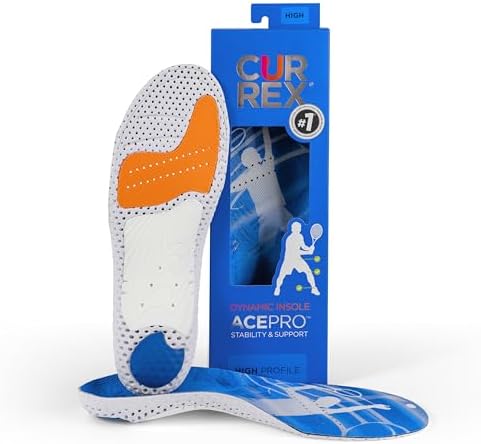
CURREX AcePro is the most directly tennis-oriented option in this group. It is designed for sports with abrupt direction changes and jumping, including tennis, volleyball, and racquetball. The insole combines dynamic arch support with a deep, decoupled heel cup intended to wrap and stabilize the heel during movement.
AcePro comes in low, medium, and high arch profiles, so selecting the profile that matches your foot is key. Its grippy surface is designed to help limit slipping inside the shoe, while the cushioning is intended to absorb shock. A mesh top layer and foam cushioning are also included for breathability and comfort.
The main advantage over general-purpose orthotics is its activity-specific design. That said, a tennis label alone does not guarantee a good fit: confirm that the high profile feels comfortable and that it works with your shoes. CURREX recommends replacing the insoles after 100 hours of play or 12 months, whichever comes first.
Pros:
- Designed for tennis and other sports with quick movement.
- Available in three arch profiles, including high.
- Deep heel cup and grippy surface are designed for a stable fit.
- Mesh top layer and cushioning support breathability and comfort.
Cons:
- You need to select the arch profile that suits your foot.
- The suggested replacement interval may be a consideration for frequent players.
Verdict: CURREX AcePro is the strongest starting point for a tennis player who wants a high-arch insole designed specifically for court movement.
IDEALRUN Running Insoles: Trimmable Support with Three Arch Choices

IDEALRUN’s sports insoles come in three arch profiles, including a high option, and feature a rigid base with cushioning at the heel and forefoot. The product is primarily described for running, jogging, hiking, and general fitness rather than tennis. Its design may appeal if you want to choose an arch profile and move the same style of support between athletic shoes.
The insoles have a deep U-shaped heel shell and a breathable mesh top layer. They are also trimmable, which can help with length fit, but trimming will not change the arch shape or make a shoe wider. Check the fit carefully in your court shoes, particularly if they have limited space or a snug upper.
Compared with CURREX AcePro, IDEALRUN offers a similar choice of arch profiles but is described for running and other fitness activities, not tennis-specific court play. It is worth considering if you want a trimmable sports insole, while players prioritizing a court-focused design may prefer AcePro.
Pros:
- Three arch profiles include a high-arch option.
- Heel and forefoot cushioning are included.
- Trimmable sizing allows length adjustment.
- Breathable mesh top layer is designed to help manage sweat.
Cons:
- Designed mainly for running and fitness, not specifically tennis.
- Trimming adjusts length but does not resolve a tight shoe fit.
Verdict: Consider IDEALRUN if you want a trimmable sports insole with a high-arch profile and are comfortable using a running-focused design for tennis.
How to Choose Insoles for Tennis High Arches
Match the Arch Profile to Your Foot
High arches are not all the same, and an insole that feels too tall or firm can be uncomfortable. Look for a high-arch option, but pay attention to how the support feels when you stand and move. CURREX and IDEALRUN offer multiple profiles, while the other picks are built around high-arch support. If you are unsure which profile suits you, consider getting advice from a foot-care professional.
Prioritize a Secure Fit for Lateral Movement
Tennis involves quick changes of direction, so the insole should sit flat and stay in place inside the shoe. A deep heel cup or a grippy top surface may help with stability, but the overall fit still depends on your shoe. Try the insert with the shoe’s original liner removed when the product instructions call for it, and check that your heel feels secure without your toes being squeezed.
Check Shoe Volume Before You Buy
Structured insoles can take up more space than a thin factory liner. If your tennis shoes already feel snug across the top or around the toes, a thicker insert may make the fit worse. Superfeet is designed for roomy footwear, while PowerStep is intended for shoes with removable factory insoles. Check the product’s fit directions and your shoe’s construction before ordering.
Choose Cushioning for Your Comfort Needs
Some players prefer a firmer, more structured feel; others want more cushioning under the heel and forefoot. WALK·HERO and PowerStep describe layered cushioning, while CURREX and IDEALRUN include cushioning intended for sports movement. Cushioning is a personal fit factor, so consider what feels comfortable for your feet and court shoes rather than assuming softer is always better.
Understand Trimming and Sizing
Some insoles are trimmed to match the shoe, while others are sold by shoe size and are designed to move between footwear without trimming. Follow the manufacturer’s sizing instructions and use your original liner as a guide when trimming. Cut gradually and check the shape inside the shoe before making further adjustments; trimming the length cannot correct an arch profile that does not suit you.
Ease Into Firm Support
A change to a more structured insole can feel different at first. WALK·HERO specifically recommends starting with a few hours per day and gradually increasing wear over one to two weeks. Use a gradual transition if the product instructions advise it, and stop using the insole if it causes persistent discomfort. For ongoing foot pain, seek guidance from a qualified health professional.
Consider How You Will Use the Insoles
If tennis is your main activity, CURREX AcePro has the clearest court-sport focus among these picks. General-purpose options may be a better fit if you also want support for walking, work, or everyday shoes. IDEALRUN is described as a running and fitness insole, so weigh that intended use against your need for tennis-specific movement support.
Frequently Asked Questions
What is the best insole for tennis players with high arches?
CURREX AcePro is the most tennis-specific option here and includes a high-arch profile. The best choice still depends on your foot, shoe fit, and preference for cushioning and support.
Can I use regular high-arch insoles in tennis shoes?
Yes, a general-purpose high-arch insole may work in tennis shoes if it fits securely and does not make the shoe too tight. Check whether the shoe’s original liner should be removed and follow the insole’s fitting instructions.
Should I choose a firm or cushioned insole?
That depends on your comfort needs. Firm support can provide a more structured feel, while cushioning adds softness underfoot. Several options combine support and cushioning, but the balance varies by product.
Do I need to remove the original insole?
Some products are designed to replace a removable factory insole. PowerStep specifies use in footwear with removable factory insoles. Check the instructions for your chosen product, and avoid stacking insoles if that makes your shoe feel tight or unstable.
Are trimmable insoles a better choice?
Trimmable insoles can help you adjust the length to your shoe. They do not change the arch height or add room inside a snug shoe, so fit the arch profile and shoe volume are still important.
How should I adjust to a new high-arch insole?
Follow the product’s directions. WALK·HERO recommends starting with two to three hours a day for one to two weeks and gradually increasing wear. If discomfort persists, stop using the insole and consider speaking with a health professional.
When should I replace tennis insoles?
Replacement timing depends on the product and how often you play. CURREX recommends replacing AcePro after 100 hours of play or 12 months, whichever comes first. Check the guidance for your specific insole and replace it if it no longer fits or feels supportive.
Final Recommendation
For tennis players with high arches, CURREX AcePro is the clearest match because it is designed for court sports and offers a high-arch profile. PowerStep Pinnacle High is a useful alternative if you want a general-purpose orthotic with a deep heel cradle, while WALK·HERO may appeal if you want firm support and layered cushioning for both sports and daily wear. Whichever you choose, confirm that the insole fits your tennis shoes without crowding your foot.