
Disclosure: As an Amazon Associate I earn from qualifying purchases. Learn more
A gyroscopic wrist ball creates resistance as its internal rotor spins faster, giving your wrist and forearm a compact workout you can adjust by changing your hand movement. For tennis players, that can make it a convenient way to work on grip, wrist control, and forearm endurance away from the court. The options below vary in how they start, what they track, and how much setup they require, so the best choice depends on your preferences and training goals.
Quick Comparison
| Product | Start method | Notable feature | Best for |
|---|---|---|---|
| JIN BD Auto-Start Wrist Ball | Thumb-press auto-start | LED rotor; storage bag and wrist strap included | A ready-to-use training kit |
| GOZATO Wrist Trainer Ball | Auto-start | Silicone grip section | A secure-feeling hold |
| WINCSPACE Wrist Trainer | Pull-string | LED lights; compact design | Shoppers who don’t mind a manual start |
| KACODIO Auto-Start Gyro Ball | Auto-start | Digital counter; metal rotor | Tracking RPM and exercise time |
| WildWhale Gyro Ball Wrist Trainer | Press-and-twist auto-start | Compact, portable design | Simple grip and forearm sessions |
Our Picks: Best Gyroscopic Wrist Balls for Tennis reviews
1. JIN BD Auto-Start Wrist Ball: A Handy All-in-One Pick

The JIN BD is an auto-start gyroscopic ball designed to train your hand, fingers, wrist, and forearm. Its setup differs from a pull-string model: press and push the rotor forward with both thumbs about eight to ten times, then release and build speed with a controlled wrist motion. That can be a useful convenience if you want to avoid keeping track of a starter cord.
The product package is listed as including the gyro ball with LED lighting, a gift box, storage bag, wrist strap, and brand card with access to tutorials and support. It requires no batteries, according to the product information. The supplied description also presents it as a grip trainer for racket sports and other activities, but it should be viewed as a supplemental exercise tool—not a substitute for tennis practice or a complete strength program.
The thumb-press start takes a little technique, so “auto-start” does not necessarily mean the rotor starts with no setup. If you want a digital counter or a clearly specified metal construction, another option may fit better. Still, its included accessories make it a practical choice for someone who wants a portable ball with a storage solution.
Pros:
- Auto-start design avoids a pull cord
- No batteries required
- Includes a storage bag and wrist strap
- LED rotor adds a visible cue while it spins
Cons:
- Starting requires several deliberate thumb presses
- No digital counter is listed
Verdict: Choose the JIN BD if you want an auto-start ball with useful carry accessories and don’t need workout tracking.
2. GOZATO Wrist Trainer Ball: A Grip-Focused Auto-Start Option
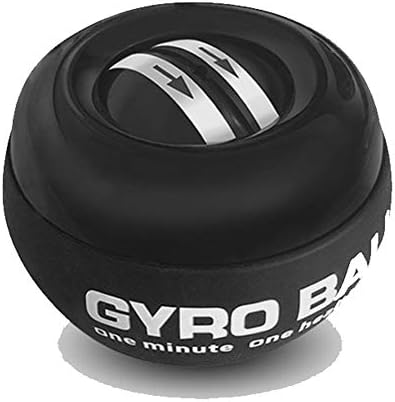
The GOZATO is an auto-start wrist and forearm exerciser for people who prefer not to use a starter string. Once the rotor is moving, the product description says it continues spinning while you keep your wrist in motion. As with other gyro balls, resistance increases as you build speed, so you can begin with a gentle pace and work on smooth control.
A silicone grip section is a notable design detail. It may help the ball feel more secure in your hand during use, though grip comfort can vary from person to person. For a tennis player, that feature may be appealing during short training sessions when you want to focus on wrist movement without gripping the device excessively.
The listing makes broad claims about rehabilitation and relief for several conditions. Those claims should not be treated as medical advice or proof that the ball can treat an injury. If you have wrist or elbow pain, ask a qualified clinician whether this type of exercise is appropriate before using it. Compared with the JIN BD, the GOZATO emphasizes its grip surface rather than a bundle of carry accessories.
Pros:
- Auto-start design does not require a pull string
- Silicone grip section is intended to help with handling
- Resistance responds to wrist speed
- Described for tennis and other sport-related grip training
Cons:
- No counter or progress display is listed
- Medical and rehabilitation claims should be approached cautiously
Verdict: The GOZATO is a reasonable match if a grippy feel and cord-free start matter more to you than accessories or tracking features.
3. WINCSPACE Wrist Trainer: A Traditional Pull-String Choice

Unlike the auto-start options in this list, the WINCSPACE uses a pull-string to get the rotor moving. That adds a setup step, but it may suit shoppers who are comfortable with a more traditional starter and want a compact device they can carry easily. After startup, the product description says you increase resistance by speeding up your wrist movement and keeping it in sync with the rotor.
The ball has LED lights that illuminate while it spins, and the listing says it does not need a battery because wrist movement powers the rotation. Its small form can work well for a desk drawer or gym bag. The product is described for grip and forearm exercise across several sports, including tennis, but it does not offer a digital counter or other listed progress-tracking feature.
The main trade-off is the string. It can be less convenient than pressing or twisting to start, especially if you prefer a quick session with minimal setup. The WINCSPACE also makes rehabilitation-related claims in its description; treat it as an exercise accessory, not a treatment for sore muscles or joint conditions.
Pros:
- Compact and portable
- LED lights show when the rotor is spinning
- No battery is required, according to the listing
- Pull-string start may appeal to users who prefer a traditional mechanism
Cons:
- Requires a pull-string start rather than an auto-start mechanism
- No digital counter is listed
Verdict: Pick the WINCSPACE if you’re comfortable with a pull-string and want a straightforward, portable gyro ball.
4. KACODIO Auto-Start Gyro Ball: A Counter for Tracking Sessions

The KACODIO stands out for its listed digital display, which is described as tracking RPM and exercise duration. If you like having a simple number to monitor during a session, that may be more useful than an LED light alone. The auto-start mechanism is intended to avoid a pull cord, and the product is positioned as a compact option for home, desk, or travel use.
Its product description lists a zinc-alloy rotor and a shock-absorbing shell. It also claims the ball can withstand high-speed rotation, but that stated performance should be understood as a manufacturer claim rather than a guarantee of how it will hold up in every situation. For tennis training, the counter may help you compare short sessions, though it does not measure on-court performance or replace a coach’s assessment of technique.
One important limitation: the supplied listing information marks this product as unavailable. Check the listing before choosing it, since availability can change. The description also promotes the ball for pain relief and specific conditions; consult a medical professional before using it to manage symptoms.
Pros:
- Auto-start design avoids a pull cord
- Digital display is listed for RPM and session duration
- Product description specifies a zinc-alloy rotor and shock-absorbing shell
- Compact form is intended for portable use
Cons:
- Supplied listing data marks it as unavailable
- Performance and durability claims are not independently verified here
Verdict: Consider the KACODIO if session tracking is your priority, but confirm it is available before settling on this pick.
5. WildWhale Gyro Ball: A Simple, Portable Auto-Start Trainer

The WildWhale is a compact auto-start wrist ball intended for grip, finger control, wrist stability, and forearm endurance. Its listed startup is to press, twist, and spin the rotor. As you move your wrist faster, the gyroscopic resistance builds, giving you a way to adjust the challenge without changing weights or adding equipment.
The product description highlights portability and use during breaks at a desk, at home, or while traveling. It is also presented for racket sports, climbing, music practice, and general hand exercise. Unlike the KACODIO, this listing does not specify a digital counter, and unlike the JIN BD, it does not list a storage bag or wrist strap in the package.
This is a relatively simple choice if you want to keep a gyro ball nearby for short, controlled sessions. The description does not provide specific material or construction details, so shoppers who care most about build materials may prefer an option with more clearly stated components. Start gently and focus on controlled motion rather than trying to reach a high speed right away.
Pros:
- Auto-start design uses a press-and-twist motion
- Compact and easy to keep in a gym bag or at a desk
- Resistance increases with wrist speed
- Described for racket sports and general grip training
Cons:
- No digital counter is listed
- Specific build materials are not provided in the supplied description
Verdict: The WildWhale suits you if you want a basic, portable auto-start ball and don’t need a counter or detailed material specifications.
How to Choose a Gyroscopic Wrist Ball for Tennis
Pick a starting method you’ll actually use
Auto-start models remove the pull cord, but the motions differ. The JIN BD calls for pressing and pushing the rotor with both thumbs several times, while the WildWhale uses a press-and-twist motion. The GOZATO and KACODIO are also described as auto-start options. The WINCSPACE uses a pull-string. Consider which setup feels easiest for you to learn and repeat.
Think about the training feature that matters most
Most gyro balls in this list rely on your wrist speed to change the resistance. If you want a number to track, the KACODIO is the only option here with a listed digital display for RPM and exercise duration. If visual feedback is enough, the JIN BD and WINCSPACE list LED lighting. Neither feature tells you whether your tennis technique is improving, so use it as a simple session aid rather than a performance score.
Consider grip and handling
A secure, comfortable hold matters when you’re building speed. The GOZATO specifically lists a silicone grip section. Other descriptions do not provide the same level of detail about grip materials, so check the product listing for current specifications and images before buying. Start with a relaxed but secure hold; gripping too hard can add unwanted tension.
Look at portability and included accessories
If you plan to carry the ball between home, work, and the court, size and storage may matter. The JIN BD lists a storage bag and wrist strap, while the WINCSPACE and WildWhale are described as compact or portable. The supplied descriptions do not list the same accessories for every model, so compare the package details rather than assuming they include a case or strap.
Set realistic tennis-training goals
A gyro ball can add a compact wrist and forearm exercise to your routine, but it does not replace hitting practice, full-body strength work, or sport-specific conditioning. Use it for controlled sessions and pay attention to how your hand and arm feel. Stop if you feel pain, and ask a qualified health professional before using one to address an injury or medical condition.
Check availability and product details
Listings, package contents, and availability can change. The supplied information marks the KACODIO as unavailable, so confirm its status if you are interested in its counter. Before purchasing any model, review the current product page for the latest details and make sure its startup method and listed features match what you want.
Frequently Asked Questions
What does a gyroscopic wrist ball train?
It creates changing rotational resistance as the internal rotor spins. The products in this list are described for exercising the wrist, hand, grip, fingers, and forearm. The exact muscles involved can depend on how you hold and move the ball.
Can a wrist ball improve my tennis game?
It may be a convenient way to add grip and forearm exercise to your routine, but it does not replace tennis practice or a complete training plan. Use it as one small part of your preparation, not as a guarantee of better play.
Are auto-start wrist balls easier to use than pull-string models?
They avoid the pull-string step, but they still require you to activate the rotor. The JIN BD uses repeated thumb presses, while the WildWhale describes a press-and-twist start. The WINCSPACE uses a pull-string. Your preferred method depends on what feels straightforward to you.
Do these wrist balls need batteries?
The JIN BD description says it requires no batteries, and the WINCSPACE description says it is powered by wrist movement and does not need a battery. The supplied information does not make the same specific battery statement for every model, so check each product listing if that detail matters to you.
Which option has a counter?
The KACODIO listing describes a digital display that tracks RPM and exercise duration. The supplied descriptions for the other four products do not list a digital counter.
Can I use a gyro ball if my wrist hurts?
Don’t assume a gyro ball will treat wrist pain or an injury. Product descriptions may make therapeutic claims, but this article cannot confirm that the device is suitable for a specific condition. Ask a qualified clinician before using one for pain, injury, or rehabilitation.
Final Recommendation
For a practical all-around choice, the JIN BD stands out for its auto-start design and included storage bag and wrist strap. Choose the GOZATO if a listed silicone grip section is more important to you, or the WINCSPACE if you prefer a pull-string start. If tracking matters most, the KACODIO is the only listed option with an RPM and time display, but its supplied availability status is unavailable. The WildWhale is a simple alternative when portability and auto-start operation are your main priorities.