
Disclosure: As an Amazon Associate I earn from qualifying purchases. Learn more
A tennis rebound trainer can help you practice basic swings without a partner, but the designs vary: some use a fillable base, while others focus on including extra balls or making setup simpler. The picks below compare five solo-training options by their included parts, base design, portability, and intended use. Keep in mind that a tethered rebound ball is best for repeated contact practice—not a replacement for rallies with a partner.
Quick Comparison
| Product | Included | Base | Best For |
|---|---|---|---|
| Teloon Solo Tennis Trainer | Two balls, base, anti-tangle hook, mesh bag | Fill with water or sand | Portable practice for adults or kids |
| Uikherxn Tennis Trainer Set | Three rebound balls, wristband, mesh bag | Fill with water or sand | A set with an included wristband |
| CHEGIF Tennis Trainer | Three string balls | Hollow, fillable design | Beginners who want a carry handle |
| Magicorange Tennis Trainer | Six string balls and a base | Fillable, with non-slip bottom | Shoppers prioritizing spare balls |
| LOQOMI Tennis Trainer | Three rebound balls | Pre-weighted; no filling required | Quick setup without adding water or sand |
Our Picks: Best Cheap Tennis Trainer Rebound Balls reviews
1. Teloon Solo Tennis Trainer: A Portable Set with a Fillable Base

The Teloon is a solo-practice kit with two tethered balls, a base, an anti-tangle hook, and a mesh carry bag. Its base can be filled with water or sand, so you can add weight before practice instead of relying on an unweighted holder.
The listing describes the balls as having a thicker core than a standard tennis ball and wool felt. It also notes an elastic, wear-resistant cord and a base design intended to help reduce tangling. You can wrap some cord around the base to adjust its length, which may help tailor the setup to the space you have available.
This is a practical choice for adults or kids who want a compact kit for a garden, park, or court. The trade-off is that you need to fill the base before use and empty or carry it appropriately afterward. Its two included balls are fewer than the three- and six-ball sets below.
Pros:
- Includes two balls, a base, an anti-tangle hook, and a mesh bag
- Fillable base lets you add water or sand for stability
- Cord length can be adjusted by wrapping it around the base
- Designed for adults and kids
Cons:
- The base needs filling before practice
- Includes fewer balls than several competing sets
Verdict: Choose the Teloon if portability and an adjustable tether matter more to you than getting the largest number of balls in the set.
2. Uikherxn Tennis Trainer Set: Three Balls and a Wristband

Uikherxn’s set includes a fillable base, three rebound balls, a sports wristband, and a mesh bag. The base is designed to be filled with water or sand, while the elastic cords return the balls after you hit them. A non-slip bottom is intended to help the base stay in place during practice.
The wristband distinguishes this kit from the other options here. The product description says it can absorb sweat and cushion impact, though it should be treated as an accessory rather than a substitute for sound technique or appropriate equipment. The listing also describes the set as intended for adults and suitable for indoor or outdoor use.
Three balls provide spares if you want to keep the session going while another ball is in use. As with other fillable-base models, you’ll need to prepare the base and choose a suitable practice area. The tethered return is useful for repetition, but it won’t reproduce the changing pace and placement of a live rally.
Pros:
- Includes three rebound balls and a wristband
- Mesh bag helps organize and carry the parts
- Base can be filled with water or sand
- Designed for solo practice indoors or outdoors
Cons:
- The base needs to be filled for use
- The wristband may be unnecessary if you already have one
Verdict: Pick the Uikherxn if you want three balls and an included wristband in one fillable-base kit.
3. CHEGIF Tennis Trainer: A Hollow Base with a Carry Handle

The CHEGIF set comes with three balls attached to elastic strings. Its hollow, kettle-style base can be filled for practice and emptied afterward. A side handle is built into the design to make carrying the trainer easier.
The base has grooves for placing balls and wrapping the cord, which may make storage more organized. The listing describes the balls as having thickened rubber inner liners and elastic nylon ropes. It also specifies a 13-foot elastic string, so this setup may need more room than a shorter tethered trainer.
This model is aimed at beginners and casual practice in places such as a garden, park, or tennis court. The product instructions recommend tying a knot on the ball’s string before use and caution against hitting the ball again before it has bounced back to the ground. Those directions are worth following to keep the ball attached and give the rebound time to reset.
Pros:
- Includes three tethered balls
- Carry handle makes the hollow base easier to move
- Grooves provide places for balls and cord during storage
- Designed for beginners and outdoor practice
Cons:
- The base needs to be filled for a stable session
- The listed 13-foot cord may call for more open space
Verdict: The CHEGIF is a sensible option for beginners who want three balls, a carry handle, and a base that can be emptied after practice.
4. Magicorange Tennis Trainer: Six Balls for Repeated Practice
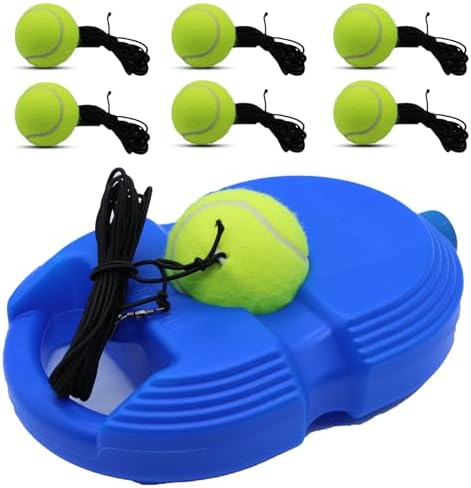
Magicorange stands out for the number of balls in the package: it includes six tethered balls and a base. The base is made from high-density PE plastic, according to the product description, and its hollow design allows you to add water or sand for weight.
The base includes a non-slip bottom, a top groove for placing balls, and an annular groove for wrapping the elastic cord. These details are intended to make setup and storage less fiddly. With six balls included, you have more spares than with the other sets in this comparison, although the listing does not specify extra features such as a carry bag or wristband.
This may suit a household where several people want to practice or a player who prefers having extra balls on hand. The main limitation is that a fillable base still takes preparation, and a tethered ball is best for focused swing repetition rather than realistic point play.
Pros:
- Includes six tethered balls and a base
- Base can be weighted with water or sand
- Non-slip bottom is designed to help hold it in place
- Grooves help store the balls and cord
Cons:
- Requires filling the base before use
- The listing does not specify a carry bag or wristband
Verdict: Choose Magicorange if having the most included rebound balls is your priority and you don’t mind preparing a fillable base.
5. LOQOMI Tennis Trainer: A Pre-Weighted Base for Faster Setup

The LOQOMI trainer comes with three string balls and a base that the product description says is pre-weighted. Unlike the fillable-base options above, it is described as ready to use without adding water or sand. That could make it a more convenient choice if you want to avoid the extra setup step.
The listing describes the cords as elastic and the design as tangle-resistant. It is intended for groundstroke and volley practice on surfaces such as hard courts, driveways, and backyards. A compact footprint and lightweight design are also listed as portability features. The racket is not included.
There is a trade-off: a pre-weighted base avoids filling, but it may not offer the same option to empty the base for transport that a hollow, fillable model does. The listing does not state how the base can be adjusted or emptied, so consider how you plan to carry and store it.
Pros:
- Three rebound balls are included
- Pre-weighted base requires no water or sand filling
- Designed for quick setup and compact storage
- Intended for beginners, kids, and adult learners
Cons:
- The racket is not included
- The base cannot be emptied for transport according to the product description
Verdict: Consider the LOQOMI if you value quick setup and want to skip filling a base, but check that its fixed weight and carrying format fit your needs.
How to Choose a Cheap Tennis Trainer Rebound Ball
Choose a base that suits your setup routine
Most of these trainers use a hollow base that you fill with water or sand. This gives you a way to add weight for practice, but it also means you need to prepare the base and plan how to move it afterward. The LOQOMI is described as pre-weighted and ready to use without filling, which may be more convenient if you want to get started quickly. Consider whether you prefer adjustable filling or less setup.
Think about how many balls you need
The sets here include between two and six rebound balls. Extra balls may be useful if you want spares on hand or expect more than one person to use the trainer. A larger count does not necessarily mean a better practice experience, though. If you only plan to work through short sessions, the included ball count may matter less than the base design and portability.
Check cord length and storage features
The tether needs enough room to move freely, and a long cord may call for a more open practice area. CHEGIF lists a 13-foot elastic string, while Teloon describes a cord that can be shortened by wrapping it around the base. Grooves, hooks, and other storage features can also help keep a cord from becoming tangled between sessions.
Match the trainer to your practice goals
A rebound ball can give you repeated chances to work on basic contact and swing rhythm on your own. It does not reproduce a rally with a partner, where the ball’s pace and placement change from shot to shot. If you are learning the basics, choose a setup that is easy to control and use in your available space. For more varied practice, combine it with partner drills when possible.
Consider portability and where you will practice
Mesh bags and carry handles can make a trainer easier to take to a park or court. A fillable base may be simpler to transport when empty, but it needs to be filled before a session. A pre-weighted base avoids that step, though you should consider its size and carrying format. Think about your storage space and how far you need to carry the kit.
Read the setup instructions before swinging
Follow the product’s directions for attaching the ball and cord, filling the base, and allowing the ball to return before hitting again. CHEGIF specifically advises tying a knot on the ball’s string before use and waiting for the ball to bounce back to the ground. A clear practice area and controlled swings can help you use a tethered trainer more comfortably.
Frequently Asked Questions
Can you use a tennis rebound trainer without a partner?
Yes. These products are designed for solo practice: you hit a ball attached to an elastic cord, and the ball returns toward you. You do not need a partner to repeat basic strokes, though the experience differs from playing a rally.
Do these trainers come with a tennis racket?
The product details do not list a racket among the included parts. The LOQOMI description specifically states that a racket is not included, so plan to use your own.
Do all of these bases need water or sand?
No. Teloon, Uikherxn, CHEGIF, and Magicorange describe fillable bases. LOQOMI is described as having a pre-weighted base that needs no filling before use.
Are rebound trainers suitable for beginners?
They can be useful for practicing repeated contact and basic swing movements. CHEGIF and LOQOMI are specifically described as suitable for beginners or learners. Use a clear area, follow the setup instructions, and allow the ball to return before striking again.
Can you practice indoors with a rebound ball?
Uikherxn’s description says its trainer is suitable for indoor use, while several other listings emphasize outdoor settings. Before using any tethered ball indoors, make sure you have enough clear space and that your surroundings are suitable for swinging a racket.
What is the main difference between a rebound trainer and a ball machine?
A rebound trainer uses an elastic cord to return the ball you hit. It is a tethered solo-practice tool, while the product descriptions here do not present these kits as ball machines. The rebound trainer can support repeated practice, but it does not provide the changing feeds of a rally.
Final Recommendation
For a portable fillable-base kit with an adjustable cord and a mesh bag, the Teloon is a balanced option. Choose the Magicorange if you want the most included balls, the Uikherxn if the wristband matters to you, or the LOQOMI if avoiding base-filling is your main priority. Compare the base style and included accessories with how you plan to practice before choosing.