
Disclosure: As an Amazon Associate I earn from qualifying purchases. Learn more
A tennis ball machine can make solo practice more structured, but the right choice depends on more than launch speed. Ball capacity, battery life, shot variety, portability, and how you control drills all affect how useful a machine will be on court. The options below offer different trade-offs, from a long-running machine with a large hopper to lightweight models with app and voice controls. If you have a firm $3,000 ceiling, check the current listing price and included accessories before you buy.
Quick Comparison
| Machine | Best for | Key specifications | Control and training features |
|---|---|---|---|
| TENNIIX Basic Tennis Ball Machine | Portable practice with hands-free controls | 18.7 lb; 100+ balls; up to 75 mph; up to 4 hours | App, wrist remote, voice commands, preset patterns |
| LUMISTAR TERO Tennis Ball Machine | Full-court movement drills | 21.7 lb; up to 87 mph; stated reach up to 85 ft | Triple-axis gimbal, app, wristband, voice control |
| PONGBOT Tennis Ball Machine | Long sessions and a large ball supply | 150-ball capacity; up to 80 mph; over 8 hours | App, remote, custom drills, six oscillation spots |
| TENNIIX PRO AI Tennis Ball Machine | Adaptive drills and shot analysis | 19 lb; 100-ball capacity; up to 75 mph; up to 4 hours | 4K vision module, app, voice armband, match modes |
| Spinshot Pro Tennis Ball Machine | Simple knob-based operation | Power options are described; battery is shipped separately | Knob controls; feature details are limited |
Our Picks: Best Tennis Ball Machines under $3000 reviews
1. TENNIIX Basic: A Lightweight Machine with Voice and App Controls

The TENNIIX Basic is designed for players who want a portable machine with several ways to control a session. It weighs 18.7 pounds, folds to a compact size, and has a removable battery rated for up to four hours or 1,800 shots per charge. Its stated capacity is 100 or more balls, so you can get a substantial practice block in before stopping to reload.
The dual-wheel launcher reaches speeds up to 75 mph. You can use the app to adjust settings such as speed, spin, launch angle, and feed timing, or use the wrist remote and voice commands for key controls. The description lists nine shot patterns and six match-play styles, giving players options beyond a repeated feed to one spot.
Its main appeal is the mix of portability and control. The trade-off is that the stated four-hour runtime is shorter than the PONGBOT’s listed runtime. Also, the AI vision module is described as an upgrade, so don’t assume it comes with the Basic model. This is a sensible fit for players who want varied practice without moving a heavier machine around the court.
Pros:
- Lightweight, folding design with a removable battery
- 100+ ball capacity and up to 75 mph launch speed
- App, wrist remote, and voice-command control
- Multiple practice patterns and match-play styles
Cons:
- Up to four hours of runtime is less than the PONGBOT’s stated runtime
- AI vision is an upgrade rather than a stated included feature
Verdict: Choose the TENNIIX Basic if you value a light, feature-rich machine and can work within its stated four-hour battery window.
2. LUMISTAR TERO: A Full-Court Option for Movement Practice

The LUMISTAR TERO is built around changing shot direction and angle. Its triple-axis gimbal is intended to move feeds around the court for forehand, backhand, and footwork practice. The machine is specified to reach up to 87 mph and send balls up to 85 feet, making its listed range the longest in this group.
You can set speed, spin, placement, feed interval, and shot count in the app, then choose a preset, custom, or random drill. A wristband and voice control let you start or pause a session without walking back to the machine. At 21.7 pounds, it is heavier than the two TENNIIX options here, but built-in wheels and a pull handle are meant to make transport easier.
The listing does not state the TERO’s ball capacity or battery runtime, so those are important details to confirm if you need long sessions between refills or charges. Its Vision Dock is an add-on for upgrading to TERO PRO, not a feature to assume is included with the base machine. Consider this model if court coverage and moving drills matter more to you than a clearly stated hopper size or runtime.
Pros:
- Triple-axis gimbal for changing feed direction and angle
- Stated top speed of 87 mph and reach up to 85 feet
- App supports custom, preset, and random drills
- Wheels and pull handle help with moving the machine
Cons:
- Ball capacity and battery runtime are not specified in the provided details
- The Vision Dock for TERO PRO is an optional upgrade
Verdict: The TERO is a strong candidate for players focused on full-court movement, provided its unspecified capacity and runtime suit your practice needs.
3. PONGBOT: Long Runtime and a 150-Ball Capacity

The PONGBOT stands out for its combination of a 150-ball capacity and a removable battery rated for over eight hours. Those specifications make it a practical choice for players who want fewer breaks to reload or recharge. Its top speed is listed at 80 mph, and it supports up to 60 rotations per second of spin, according to the supplied product details.
For training variety, it offers six oscillation spots, app and remote controls, and the ability to sync 30 drills from the app to the remote. The description also mentions hundreds of preloaded drills, custom drills, and a user community for sharing them. Wheels, a pull handle, and a compact car-trunk design help with transport, while a remotely controlled barrel opening is intended to simplify ball pickup and cleaning.
There is a configuration detail worth checking before purchase: the description refers to “PACE S PRO” smart sensors for adaptive rallies and NTRP match challenges, but does not clearly explain which exact version includes those features. Confirm the model and included functions on the listing. Compared with the lighter TENNIIX machines, this one’s key advantage is its longer stated runtime and larger capacity, not the highest listed speed.
Pros:
- Large 150-ball capacity
- Removable battery rated for over eight hours
- App and remote controls with drill syncing
- Wheels and pull handle for transport
Cons:
- The exact inclusion of the described PACE S PRO sensor features is unclear
- Its stated top speed is lower than the LUMISTAR TERO’s
Verdict: Pick the PONGBOT if a large hopper and long stated runtime are your priorities, after confirming which smart features are included in the specific configuration.
4. TENNIIX PRO AI: Adaptive Practice with 4K Vision

The TENNIIX PRO AI adds camera-based tracking to a portable ball machine. Its 4K vision module, dual cameras, and UWB sensing are described as tracking ball speed, trajectory, landing point, and player position. The stated purpose is to support adaptive feeds instead of relying only on fixed or random patterns.
Training options include Track and Recovery Training, which is designed to wait for a return to a recovery zone, plus Smart Match and Challenge modes. The machine holds 100 balls, reaches up to 75 mph, and offers nine shot types with adjustable topspin and backspin. It weighs 19 pounds and is rated for up to four hours per charge. App controls cover a range of settings, while the included voice armband provides hands-free control.
This model is the most focused option here for players who want the machine to respond to movement and analyze shot placement. That added system may be more than you need if your goal is simply to repeat the same feed for technique work. Its four-hour runtime is also shorter than the PONGBOT’s stated figure, so consider how long your typical sessions last.
Pros:
- 4K dual-camera and UWB system for tracking player and ball information
- Recovery, match, and challenge training modes
- 100-ball capacity and up to 75 mph launch speed
- Portable 19-pound design with app and voice controls
Cons:
- Up to four hours of runtime is shorter than the PONGBOT’s stated figure
- Its adaptive and analysis features may be unnecessary for basic repetition drills
Verdict: Choose the TENNIIX PRO AI if movement-aware drills and shot tracking matter more to you than maximum runtime or a simple setup.
5. Spinshot Pro: Straightforward Knob Controls
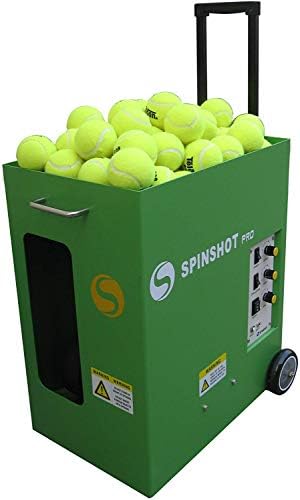
The Spinshot Pro takes a simpler approach than the app-connected machines in this list. Its description highlights knob controls and says the machine is designed to be easy to use, including for children. It also notes flexible power options, though it does not provide specific launch speeds, ball capacity, or runtime in the supplied details.
The most important purchasing detail is the battery: the listing says the charger is included, but the actual battery is shipped separately and is not included in the machine box. Plan for that separately, and confirm which power setup and accessories you need before ordering.
Compared with the other options here, the Spinshot Pro offers less detail about drill variety and performance. That makes it harder to compare on speed, capacity, or practice modes. Its appeal is its more direct control style, which may suit someone who does not want to adjust sessions through an app or voice commands.
Pros:
- Knob controls provide a simple alternative to app-based operation
- Described as easy to use
- Flexible power options are noted in the product description
Cons:
- The battery is shipped separately and is not included in the box
- Speed, capacity, runtime, and drill details are not provided here
Verdict: Consider the Spinshot Pro if you prefer knob controls, but confirm the battery and power arrangement before making it your choice.
How to Choose a Tennis Ball Machine
Match the Machine to Your Practice Goals
If you mainly want to repeat forehands or backhands, a machine with straightforward controls and consistent feeds may be enough. Players working on court coverage should look for adjustable placement, oscillation, or gimbal movement. For more complex sessions, app-based custom drills and adaptive modes can offer greater variety, but those features are useful only if you plan to use them.
Compare Ball Capacity with Session Length
A larger hopper means fewer interruptions to collect and reload balls. The machines in this list include stated capacities of 100 or more and 150 balls, while some listings do not provide a capacity figure. Think about whether you practice alone, how long you plan to train, and how often you are willing to stop for refills.
Check Battery Runtime and What Comes in the Box
Runtime can range from a stated four hours on the TENNIIX models to over eight hours on the PONGBOT. These are manufacturer-provided figures, so your actual session may vary with use. Check whether the battery is included, removable, and ready to use; the Spinshot Pro listing specifically says its battery is shipped separately and is not included in the box.
Choose a Speed and Shot Range You Can Use
A high top speed can matter for advanced drills, but it is not the only measure of a useful machine. Adjustable spin, launch angle, feed timing, and shot placement help you tailor practice to your skill level. The listed top speeds range from 75 mph to 87 mph for the machines with stated figures. Do not compare models on speed alone, especially when some listings do not provide a speed specification.
Think About Transport and Storage
Consider the machine’s weight, folded size, handles, wheels, and how it will fit in your vehicle or storage area. The TENNIIX models weigh under 20 pounds, while the LUMISTAR TERO is listed at 21.7 pounds and has wheels and a pull handle. A compact design can make regular practice easier, but check the dimensions and carrying setup against your own needs.
Decide Whether Smart Features Are Worth It
Apps, wrist remotes, voice commands, tracking systems, and drill libraries can make it easier to adjust a session without walking back to the machine. They also add complexity compared with basic controls. If you are considering an upgrade or a model with a named smart feature, verify whether it is included in the exact configuration or sold separately.
Confirm Price, Availability, and Accessories
Prices and availability can change, so check each listing before buying to make sure the machine fits your budget. Read the included-items details carefully, especially for batteries, chargers, remotes, and optional vision modules or docks. A machine’s listed features matter only if the components you need are part of the version you order.
Frequently Asked Questions
Which machine has the longest stated battery runtime?
The PONGBOT is listed with over eight hours of runtime. The TENNIIX Basic and TENNIIX PRO AI are each listed for up to four hours per charge. The supplied LUMISTAR TERO and Spinshot Pro details do not state a runtime.
Which option has the largest stated ball capacity?
The PONGBOT has the largest stated capacity in this comparison at 150 balls. The TENNIIX Basic holds 100 or more, and the TENNIIX PRO AI is listed with a 100-ball capacity. The other supplied descriptions do not specify capacity.
Which machine has the highest stated top speed?
The LUMISTAR TERO has the highest stated top speed at 87 mph. The PONGBOT is listed at up to 80 mph, while the two TENNIIX models are listed at up to 75 mph. The Spinshot Pro details provided do not state a speed.
Do these machines need a phone app?
No. The Spinshot Pro description highlights knob controls. The TENNIIX, LUMISTAR, and PONGBOT options also describe app controls, and some include a wrist remote, wristband, or voice control. Check the feature list for the exact model you are considering.
Does the Spinshot Pro include a battery?
The supplied listing details say the charger is included, but the actual battery is shipped separately and is not included in the machine box. Confirm the battery and power requirements before ordering.
Are the vision and AI features included with every machine?
No. The TENNIIX Basic description presents its AI vision module as an upgrade, and the LUMISTAR TERO’s Vision Dock is described as an add-on for upgrading to TERO PRO. The TENNIIX PRO AI description lists its 4K vision module as included. For any model, confirm the contents of the exact configuration before purchase.
Final Recommendation
For long practice sessions with fewer reloads, the PONGBOT is the clearest fit based on its stated 150-ball capacity and over-eight-hour runtime, though you should confirm which smart features come with the configuration. The TENNIIX Basic is a compelling portable choice if you want app, wrist, and voice controls, while the LUMISTAR TERO is worth considering for its stated speed and full-court reach. Choose the TENNIIX PRO AI for adaptive practice and tracking, or the Spinshot Pro if you prefer simpler knob controls and have checked its separately shipped battery. Before deciding, verify the current price, availability, and included accessories on the listing.