
Disclosure: As an Amazon Associate I earn from qualifying purchases. Learn more
A tennis ball machine can make solo practice more focused, but the right choice depends on the drills you want, how much gear you can carry, and whether you need a true powered launcher. This shortlist includes portable, app-controlled machines, a knob-operated option, and a rebound-style trainer. Product prices and availability can change, so check each listing to confirm it fits your budget of under $1,500 before buying.
| Product | Standout features | Best suited for |
|---|---|---|
| LUMISTAR TERO Tennis Ball Machine | App and wristband control, triple-axis gimbal, speeds up to 87 mph | Players who want varied, programmable court drills |
| TENNIIX PRO AI Tennis Ball Machine | 4K vision module, voice control, up to 100-ball capacity | Players interested in movement-aware training |
| Spinshot Pro Tennis Ball Machine | Knob controls and flexible power options | Players who prefer straightforward controls |
| Veva R3 Pro Tennis Ball Machine | 28 programmable shot locations, voice control, up to 80-ball capacity | Players who want structured placement drills |
| Fast Track Feedback System GEN2 | Rebound-style practice and varied shot angles | Players considering a trainer rather than a conventional launcher |
Our Picks: Best Tennis Ball Machines under $1500 reviews
LUMISTAR TERO: Best for app-guided, full-court drills

The LUMISTAR TERO is a portable, app-controlled tennis machine designed for varied solo practice. Its triple-axis gimbal changes shot direction and angle, and the listed top speed is 87 mph with a reach of up to 85 feet. Those features give you room to work on baseline-to-baseline feeds as well as forehand, backhand, and footwork drills.
The app lets you adjust placement, speed, spin, feed interval, and shot count. You can choose a preset, create a custom sequence, or use random patterns. A wristband remote and voice commands are intended to let you start, pause, and adjust a session without repeatedly walking back to the machine.
At 21.7 pounds, it is designed to be moved between a car and court, with built-in wheels, a pull handle, and a detachable ball bag. Its main drawback is the listing’s stated availability: the supplied product information marks it unavailable. The optional Vision Dock is also described as a separate upgrade for PRO features, so don’t assume the machine includes those capabilities.
Pros:
- Triple-axis movement supports varied shot direction and angle.
- App controls include custom and random drill options.
- Wristband and voice controls can reduce trips to the machine.
- Wheels and a pull handle help with transport.
Cons:
- The supplied listing information indicates it may not be available.
- The Vision Dock is an optional upgrade, not a stated standard feature.
Verdict: Choose the TERO if app-led drills and a broad range of shot patterns matter most, but confirm availability and included features before committing.
TENNIIX PRO AI: Best for movement-aware practice features

The TENNIIX PRO combines a ball launcher with a 4K vision module and app-based training tools. Its description says the dual cameras and UWB sensing track ball speed, trajectory, landing point, and player position. Track and Recovery Training is designed to wait for you to return to a recovery zone before sending the next ball, while Smart Match and Challenge modes offer other ways to structure a session.
The machine holds up to 100 balls and lists a maximum speed of 75 mph. You can adjust feed intervals, spin, elevation, and horizontal placement, with nine shot types and 14–48-degree elevation. The Tenniix app offers preset drills as well as custom sessions, and a voice armband provides hands-free control.
At 19 pounds, it is one of the lighter options in this lineup. The description lists a removable battery and up to four hours of operation per charge, which may suit players who practice away from a convenient outlet. The trade-off is that its many sensing and training features may be more than you need if you mainly want simple, repeatable feeds. Check the listing for the exact package contents and current price.
Pros:
- Movement-aware modes are designed to include recovery positioning.
- Up to 100-ball capacity helps limit refill breaks.
- App and voice controls offer several ways to set up drills.
- Portable design includes a removable battery and shoulder strap.
Cons:
- The advanced vision features may be unnecessary for basic feeding practice.
- Its stated top speed is lower than the TERO’s listed maximum.
Verdict: The TENNIIX PRO is a strong fit if you want portable practice with player tracking and varied modes, rather than a basic launcher with only simple controls.
Spinshot Pro: Best for simple, knob-based operation
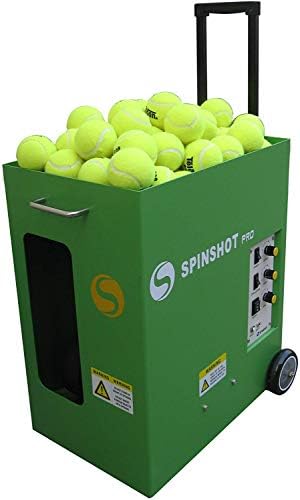
The Spinshot Pro is a more straightforward choice for players who want physical controls instead of relying on an app. Its listing describes the machine as knob-controllable and emphasizes ease of use. That simpler approach may suit players who want to set up a session without navigating multiple menus or connected features.
The product information also lists flexible power options, but it includes an important caveat: the battery charger is included while the actual battery ships separately and is not included in the machine box. That extra step can affect both setup and total cost, so check what is included in the specific listing before ordering.
Compared with the TENNIIX and LUMISTAR models, the supplied description does not give detailed ball speed, hopper capacity, drill programming, or portability specifications. That makes it harder to compare performance on paper. Its appeal is its simpler control style, but shoppers who need detailed training modes should look closely at the more feature-rich options.
Pros:
- Knob controls offer a simple alternative to app-based setup.
- Flexible power options are listed.
- Charger is included according to the product description.
Cons:
- The battery is shipped separately and is not included in the box.
- The supplied description does not specify key performance details such as speed or capacity.
Verdict: Consider the Spinshot Pro if you value direct knob controls, but confirm battery availability, package contents, and performance details first.
Veva R3 Pro: Best for location-based footwork drills

The Veva R3 Pro is aimed at structured practice, with 28 programmable shot locations and horizontal oscillation. It offers topspin and backspin, while voice control is designed to let you start, stop, and adjust drills without leaving your side of the court. Those features make placement work and movement practice its main strengths on paper.
The hopper holds up to 80 balls, with feed intervals listed from one to nine seconds. The manufacturer also describes up to six hours of practice, a 7.5 kg (16.5 lb) body, and a carbon brush motor. These specifications suggest a machine built for repeated practice sessions, though actual run time can depend on use and setup.
The supplied product information marks this model as unavailable, so check the listing before planning a purchase. It also lists an optional remote, so don’t assume a remote is included. Compared with the TENNIIX PRO, the Veva focuses on programmable shot locations rather than player-tracking features.
Pros:
- 28 programmed locations support a broad range of placement drills.
- Topspin and backspin are listed, along with horizontal oscillation.
- Voice control can help keep practice moving.
- Listed weight is 16.5 pounds, with an 80-ball hopper.
Cons:
- The supplied listing information indicates it may not be available.
- The remote is described as optional.
Verdict: The Veva R3 Pro suits players who want programmed placement and spin drills, provided you can find it available and confirm which controls come in the package.
Fast Track Feedback System GEN2: Best as a rebound-style practice alternative

The Fast Track Feedback System GEN2 is listed among tennis machines, but its supplied description focuses on a rebounder or practice-wall setup rather than a conventional powered ball launcher. It is described as a solo training aid with varied shot angles, intended to help players work on technique, reflexes, accuracy, and footwork.
The title lists 20 feeds per minute, but the description does not provide the detailed launcher specifications you would want for comparing a standard machine, such as ball capacity, speed range, power source, or app controls. Treat it as a different kind of practice tool: it may suit players seeking a simple way to hit and react, but it should not be assumed to deliver programmed feeds across a full court.
Because it differs from the other products here, compare the training style—not just the product category—before buying. If your goal is a machine that sends balls to chosen locations at set intervals, one of the powered models is a closer match.
Pros:
- Designed for solo tennis practice.
- Rebound-style setup is intended to provide varied shot angles.
- Can support reflex and technique work without a hitting partner.
Cons:
- The description does not establish that it works like a conventional powered ball machine.
- Key launcher details such as capacity and power source are not provided.
Verdict: Choose the Fast Track system only if a rebound-style trainer fits your practice plan; for programmable ball feeds, look at the other machines in this guide.
How to Choose a Tennis Ball Machine
Match the machine to your practice goals
Start with the skills you want to build. If you need repeatable feeds for a particular stroke, look for control over shot direction, interval, and spin. For footwork and recovery practice, programmable locations or movement-aware modes may be more useful. A rebounder can help with solo hitting, but it is not the same as a machine that launches balls to set positions.
Compare speed, spin, and placement controls
Maximum speed is only one part of a useful practice session. Check whether the machine offers the spin, elevation, and left-to-right placement that match your level and drills. The products here vary considerably: some list detailed placement settings and multiple shot types, while the Spinshot description provides fewer performance details. Avoid choosing based on a top-speed figure alone.
Think about hopper size and feed intervals
A larger hopper can mean fewer breaks to reload, while adjustable feed intervals help you set a pace that suits your drill. The TENNIIX lists a capacity of up to 100 balls, and the Veva lists up to 80. Check that the stated capacity and interval options support the way you plan to practice.
Check power and expected session length
Look at whether a machine uses a removable battery, what accessories are included, and how long it is listed to run per charge. The TENNIIX description lists up to four hours per charge, while the Spinshot listing says its battery is sold separately. Confirm the exact package details so you can account for any additional equipment you need.
Consider carrying and storage
If you need to move the machine from your car to the court, weight, wheels, handles, straps, and removable parts can make a real difference. The TERO lists wheels and a pull handle, while the TENNIIX includes a shoulder strap and is listed at 19 pounds. Compare those details with how far you typically carry your equipment.
Choose controls you will actually use
App controls can provide custom drills and detailed adjustments, but they may be unnecessary if you prefer simple physical controls. Voice or wristband controls can help you change settings without walking back to the machine. Think about whether you want a connected training system or a more direct setup, and check which remotes or accessories are included rather than optional.
Confirm availability, price, and included features
Prices and stock can change, and the supplied listing information marks the TERO and Veva as unavailable. Check the current listing before you decide, and confirm that the product fits your $1,500 limit. Also review which batteries, remotes, vision modules, and other accessories come with the model you are considering.
Frequently Asked Questions
Are all five products conventional tennis ball machines?
No. The LUMISTAR, TENNIIX, Spinshot, and Veva are presented as ball machines. The Fast Track description focuses on a rebounder or practice-wall trainer, so it may not provide the programmed feeds you expect from a powered launcher.
Which option lists the highest ball speed?
The LUMISTAR TERO lists speeds up to 87 mph. The TENNIIX PRO lists up to 75 mph. The supplied descriptions do not give a maximum speed for the other products.
Which machine has the largest stated ball capacity?
The TENNIIX PRO lists a capacity of up to 100 balls. The Veva R3 Pro lists up to 80 balls. The supplied information does not specify hopper capacity for the other options.
Do these machines work without an app?
The Spinshot Pro is described as knob-controllable. The LUMISTAR and TENNIIX descriptions emphasize app controls, while the Veva also lists voice control. Check the product listing for the precise controls included with the version you are considering.
Does the Spinshot Pro include its battery?
The supplied product description says the charger is included, but the actual battery ships separately and is not included in the machine box. Confirm battery availability and any additional cost before ordering.
Which option is best for solo footwork practice?
The LUMISTAR TERO lists varied shot direction and angle, the Veva lists 28 programmable locations, and the TENNIIX includes movement-aware recovery training. The best fit depends on whether you prefer custom placement, preset locations, or player-position features.
Final Recommendation
For a feature-rich portable launcher, the TENNIIX PRO stands out for its listed capacity, voice control, and movement-aware practice modes. The LUMISTAR TERO is appealing for app-based drill customization and a higher stated maximum speed, but its supplied availability status is a concern. If you prefer simpler controls, consider the Spinshot Pro after confirming the separate battery details. Before purchasing any option, check the current listing, included accessories, and final price against your budget.