
Disclosure: As an Amazon Associate I earn from qualifying purchases. Learn more
A tennis swing trainer can help you work on swing rhythm and technique when you don’t have a hitting partner nearby. The options below use different approaches: magnetic resistance, audible cues, or a tethered ball for repeated contact practice. Choose based on the skill you want to practice and where you plan to use it.
Quick Comparison
| Trainer | Training style | Best for |
|---|---|---|
| MOOJAY Tennis Power Trainer | Adjustable magnetic resistance and sound cue | Practicing swing mechanics with resistance |
| SCIENSWING Tennis Swing & Serve Trainer | Retractable tool with click feedback | Working on swing and serve rhythm |
| owfccla Tennis Swing Trainer | Weighted slider with audible cue | Practicing tempo and acceleration |
| Teknigoo Tennis Swing Trainer with Pulley | Tethered ball with adjustable height | Solo ball-contact drills |
| Selacca Tennis Training Rod | Portable magnetic-resistance trainer with sound cue | Practicing swing timing on the go |
Our Picks: Best Tennis Swing Trainers reviews
1. MOOJAY Tennis Power Trainer: Adjustable Resistance and Sound Feedback

The MOOJAY trainer combines adjustable magnetic resistance with a sound cue intended to signal a correctly timed swing. The listed resistance range is 11–33 N, giving you a way to change the feel of the exercise as your training needs change.
Its 1:1 replica grip is designed to feel like a standard racket handle, and the product description lists sweat-resistant PP material. The trainer focuses on practicing the swing sequence and feeling how the wrist, arm, and body work together. It can be useful for deliberate, repeatable movement practice, but it doesn’t replace hitting a ball or getting technique feedback from a coach.
Compared with the simpler Selacca rod, this model provides a stated resistance range and a more detailed grip specification. Its two-year guarantee is also listed in the product description. The trade-off is that its sound cue and resistance are training aids, not proof that every part of your stroke is correct.
Pros:
- Adjustable magnetic resistance is listed from 11–33 N.
- Sound feedback provides a cue during practice.
- Replica grip aims to provide a familiar racket-handle feel.
- Product description lists a two-year guarantee.
Cons:
- Does not provide real ball contact or court movement practice.
- A sound cue alone cannot confirm full-body technique.
Verdict: Choose the MOOJAY if you want resistance and an audible cue in one trainer, and plan to pair it with regular court practice.
2. SCIENSWING Swing and Serve Trainer: Retractable Click Cue

The SCIENSWING is described as a retractable swing and serve trainer with click feedback. Its stated purpose is to help you work on rhythm and fluidity while practicing without a ball. That makes it a straightforward option if you want a cue to listen for as you repeat a motion.
The available product information is limited, so details such as resistance settings, grip material, and adjustment options aren’t specified. If those features matter to you, compare the listing carefully with the more fully described MOOJAY or Selacca trainers before choosing.
Unlike the Teknigoo pulley system, this tool is not described as a tethered ball for contact drills. It is better suited to rehearsing a swing or serve motion than practicing ball placement or rebound timing. Use the click as one practice signal, not as a complete assessment of your technique.
Pros:
- Retractable design is stated in the product title.
- Click feedback offers an audible practice cue.
- Listed for both swing and serve practice.
Cons:
- Product details provide little information about construction or adjustment.
- Does not provide the ball-contact practice of a tethered trainer.
Verdict: Consider the SCIENSWING if your main goal is a simple audible cue for rehearsing swings and serves, but verify the product details before buying.
3. owfccla Weighted Swing Trainer: Slider Feedback and Noise-Reduction Pads
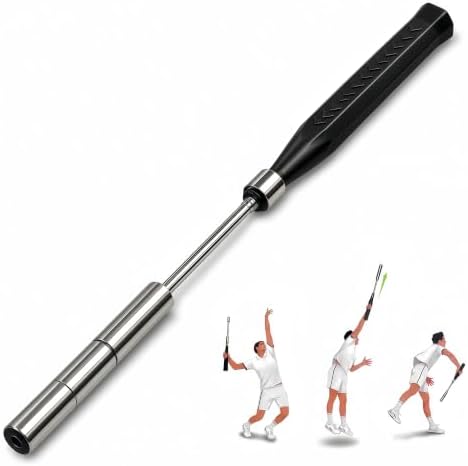
This trainer uses a moving weighted slider that produces a click when it reaches a target acceleration, according to its description. The slider adds resistance during the swing and is intended to help you focus on tempo, timing, and acceleration. A detachable weight is also noted in the product title.
Two removable noise-reduction pads are included for quieter practice, and the package description also lists a tennis overgrip. Those details may make this a more convenient choice for indoor sessions than a louder, unpadded training stick. Even with the pads, check the product’s sound and practice guidance if noise is a concern in your home.
The supplied listing information marks this product as unavailable, so it may not be a practical choice right now. If it becomes available, its weighted-slider approach offers a different feel from the magnetic-resistance trainers, while still not providing live ball contact.
Pros:
- Moving slider provides audible feedback tied to acceleration.
- Weighted resistance is intended to support swing practice.
- Includes removable noise-reduction pads and an overgrip.
Cons:
- The supplied listing information marks it as unavailable.
- Sound feedback does not assess every part of your stroke.
Verdict: This could suit players interested in a weighted slider and quieter indoor practice, but check availability before planning to buy it.
4. Teknigoo Pulley Trainer: Adjustable Height for Ball-Contact Drills

The Teknigoo takes a different approach from a swing stick: it uses a ball attached to a rope and pulley so you can practice repeated contact on your own. Its height is listed as adjustable from 3 to 12 feet, and the product description says it can be attached to supports such as trees, fences, or garage beams.
Because it gives you a ball to strike, this trainer can help you rehearse contact and observe how the ball rebounds. The description also mentions groundstroke, volley, serve, and reaction practice. You’ll need a suitable, secure mounting point and enough clear space to swing safely. The product’s weather-resistant rope and clips are intended for outdoor use, but inspect the setup and mounting point before each session.
Unlike the MOOJAY and Selacca rods, this setup doesn’t focus on magnetic resistance or a sound cue. It may be a better match if you want repeated ball contact, but it requires more space and setup than a handheld trainer.
Pros:
- Adjustable height is listed from 3 to 12 feet.
- Tethered ball supports repeated solo contact practice.
- Product description lists mounting options for different settings.
- Designed for several types of stroke and reaction drills.
Cons:
- Requires a secure attachment point and clear practice space.
- Does not provide the resistance-based swing cue of a training rod.
Verdict: Pick the Teknigoo if you want a solo ball-contact tool and have a safe place to mount it.
5. Selacca Training Rod: Portable Magnetic Resistance and Sound Cue

The Selacca is a portable training rod with adjustable magnetic resistance and audible swing feedback. Its product description positions it for players working on swing mechanics, timing, and consistency, with resistance levels to adjust to different training needs.
The listed features are simple: a lightweight design, a comfortable grip, adjustable resistance, and a sound cue when the swing is performed correctly. This could be convenient if you want a trainer to carry between home and the court. The description does not give a resistance range or specify the grip material, so those comparing fine details may prefer the MOOJAY, which lists both.
Like other handheld swing trainers, the Selacca lets you repeat the motion without a partner, but it cannot recreate the full demands of hitting a live ball. Treat the sound cue as a prompt to focus on your movement, then check your technique during regular practice.
Pros:
- Lightweight design is intended to be easy to carry.
- Adjustable magnetic resistance suits different training needs.
- Audible cue gives you feedback during swing practice.
- Product description highlights a comfortable grip.
Cons:
- No specific resistance range is provided in the supplied details.
- Does not provide live ball-contact practice.
Verdict: The Selacca is a practical option if portability and adjustable resistance matter more to you than detailed specifications or ball-contact drills.
How to Choose a Tennis Swing Trainer
Decide what you want to practice
Handheld trainers are mainly for repeating a swing motion and focusing on rhythm, resistance, or a sound cue. A tethered-ball system is a better fit if you want to strike a ball repeatedly without a partner. Neither style covers every part of tennis, so think about whether your priority is swing rehearsal or ball contact.
Choose the feedback that helps you focus
Some trainers use a click or snap as a cue, while others add magnetic resistance or a moving weight. A sound can help you notice timing, but it does not confirm that your grip, contact point, or body position is correct. Use feedback as one signal alongside instruction and practice.
Consider resistance and adjustability
If you want to change the effort of your practice, look for a trainer with adjustable resistance and clear information about its settings. The MOOJAY lists a specific resistance range, while Selacca describes adjustable resistance without stating a range in the supplied details. Avoid treating extra resistance as a shortcut to better technique; controlled movement is the priority.
Think about where you will train
A portable rod can be easier to use at home or take to the court. A pulley trainer needs a secure mounting point and enough room to swing, and it may be less convenient to set up. If you plan to practice indoors, consider both the available space and the sound the tool may make.
Check the grip and overall handling
A comfortable, secure grip matters when you are repeating a motion. The MOOJAY describes a racket-style replica grip, while Selacca highlights a comfortable handle. Since the feel of a handle is personal, read the product details closely and consider whether its stated design matches what you prefer.
Use a trainer as part of a broader practice plan
These tools can support repetition, but they do not fully reproduce a rally, court positioning, or live ball response. Combine trainer sessions with court time, and ask a coach to check your technique if you are unsure whether the movement you are repeating is sound.
FAQs
What does a tennis swing trainer help you practice?
Depending on the design, it can help you repeat a swing, focus on rhythm and timing, work against resistance, or practice striking a tethered ball. It is a practice aid, not a complete substitute for hitting on court.
Can a swing trainer improve my tennis technique?
It can give you a way to repeat movements and focus on specific cues. However, a trainer cannot assess every part of your form, so combine it with regular hitting and coaching or instruction when possible.
Which option is best for practicing ball contact alone?
The Teknigoo pulley trainer is the option in this list described with a tethered ball for repeated contact drills. It requires a suitable mounting point and clear space.
Are magnetic-resistance trainers suitable for beginners?
The MOOJAY and Selacca descriptions both present their trainers as suitable for different skill levels or beginners. Start with controlled movement and use resistance that lets you maintain comfortable form.
Can I use these trainers indoors?
Handheld trainers may be easier to use in a small space, but you still need room to swing safely. The owfccla description includes removable noise-reduction pads for indoor practice. A pulley trainer needs more space and a secure mount.
Do sound cues mean I have a perfect swing?
No. A click or snap can act as a timing or acceleration cue, but it cannot confirm every detail of your mechanics. Use it as a prompt, not a guarantee.
Final Recommendation
The MOOJAY is the most feature-specific choice if you want adjustable magnetic resistance, sound feedback, and a racket-style grip. Choose the Teknigoo instead if repeated ball contact is your priority and you have a safe place to mount it. For a more portable, straightforward resistance trainer, consider the Selacca. Whichever you choose, use it to support—not replace—regular court practice.